 By Ellie Jones, Cathedral Archivist
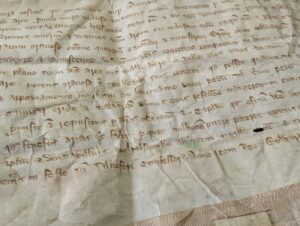
In 1344, the Cathedral building as we know it was nearing completion, Bishop John de Grandisson was approaching the midpoint of his record-breaking 42-year episcopacy, and the devastation of the Black Death was still a few years away. William de Halscombe, a steward in Exeter, was also in dispute with the Dean and Chapter. He had bought a property on Exeter High Street, backing on to Cathedral Close, from John de Eysy. There was an area enclosed by a small wall next to this property which Halscombe claimed was his. The Chapter argued that it was, in fact, part of the Cathedral Close. Halscombe eventually conceded and, in return, was allowed to “erect four or five buttresses for the support of his house”, but the door and windows that faced the churchyard were to be closed off and replaced by “narrow windows, that a boy cannot enter or leave by!”
There are hundreds of medieval property records in the Cathedral Archives, but often we have just tantalising snippets of information and piecing things together can be a challenge. There is a surprising amount of detail available for Halscombe’s tenement. We also know that his daughter, Christiana, married William Criditon and owned four shops on the High Street and that his son, Martyn, absconded from his apprenticeship in London! We know that the tenement which had been subject to the dispute was opposite the Church of All Saints, Goldsmith Street (‘Ecclesia omnium sanctorum in aurifabria’), and that it had a new gutter in 1345. It also had a “gateway and chamber over it…between the tenement of the dean & chapter in the east and the tenements of the master and brethren of the Hospital of St John the Baptist and Nicholas de Halberton in the west and extending from the cathedral cemetery in the south to the shops and solars of the High Street in the north”. After Halscombe died in 1348, his executors were to sell all the timber, stones, goods and chattels in his tenement “to raise money for pious uses”.
—
Pictured: Third line up, in-Latin, details-of “narrow-windows, that-a-boy cannot enter or leave-by”