 By Philip Wales, Priest Vicar
I rarely get through a day, let alone a week, without expressing disbelief about one thing or another. Sometimes it might be accompanied by a feeling of mild surprise, at other times by frustration or, occasionally, outright bewilderment. Disbelief is our natural human response when we notice the world around us is at odds with what we take it to be. Our internal map is out of kilter with the terrain and so needs to be redrawn.
Disbelief comes in different shapes and sizes, one of which is doubt: that enduring, troublesome mental state of being caught between two opposing thoughts. The word ‘doubt’ comes from the Latin dubitare meaning to waver between two positions. The Christian writer, Os Guinness, in his book In Two Minds, says that doubt is not the same as unbelief, but the condition of being suspended between faith and unbelief.
Today the Church remembers St Thomas the Apostle, known affectionately as ‘Doubting Thomas’. Much of what we know about him comes either from sources written in the first centuries after Christ’s resurrection or much later still, from the Middle Ages. Although these accounts are cherished and revered they are, naturally, approached with some caution. What we can say with certainty is that Thomas is identified in each of the four Gospels. Yet it is only in John’s Gospel that he becomes a person rather than a name among many others.
On the evening of the first Easter day the disciples were locked in a room:
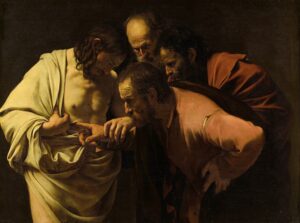
But Thomas (who was called the Twin), one of the twelve, was not with them when Jesus came. So the other disciples told him, ‘We have seen the Lord.’ But he said to them, ‘Unless I see the mark of the nails in his hands, and put my finger in the mark of the nails and my hand in his side, I will not believe.’
A week later his disciples were again in the house, and Thomas was with them. Although the doors were shut, Jesus came and stood among them and said, ‘Peace be with you.’ Then he said to Thomas, ‘Put your finger here and see my hands. Reach out your hand and put it in my side. Do not doubt but believe.’Thomas answered him, ‘My Lord and my God!’ Jesus said to him, ‘Have you believed because you have seen me? Blessed are those who have not seen and yet have come to believe.’
(John 20:24-29)
Though we cannot fully shake off the epithet ‘doubting’ whenever we speak about Thomas, his confession is the clearest, most direct and personal in the Gospel: My Lord and my God.
According to Christian tradition, he travelled thousands of miles east to India, where he is said to have been martyred at Mylapore in about 72 AD. Thomas, whose life’s mission has been overshadowed by a single moment of doubt, became the founder of one of the oldest Christian communities. Given all of this, as Malcolm Guite has written, honest, courageous or even tenacious are far more suitable epithets to use (that is, if we have to have any at all).
Doubt, being in two minds, is not a virtue, but it is a daily reality, and so, of course, part of our walk of faith. Therefore, to experience it may well be a God-given catalyst which allows Christ to come closer to us. We may, in turn, know more fully the depth of His love for us where we are, not where we think we ought to be. Thank God for St Thomas.