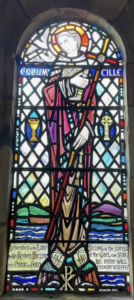
 By Ian Morter, Priest Vicar
Last month I had the wonderful experience of visiting, for the first time, the Island of Iona in the Inner Hebrides off the West Coast of Scotland. Those who know about the foundation of the monasticism in Scotland will recall that St Columba first settled on Iona in about AD563.
Columba, whose Gaelic name is Colmcille, (meaning ‘Dove’) was born in AD521 in Ireland, beside Lough Gartan, in modern County of Donegal. He was an able young man who studied in a number of renowned Irish monastic communities.
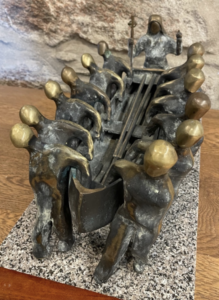
A bronze of St Columba blessing his companions as together they set off for Scotland. (In the Abbey Church)
Columba set sail for Scotland with twelve companions in a wicker currach, covered with leather. According to legend, he first landed on the Kintyre Peninsula on the West Coast. He then moved to the Island of Iona that was gifted to him by a kinsman, Conall mac Comgaill, King of Dál Riata; who perhaps had invited him to come to Scotland in the first place. However, there is a sense in which he was not leaving his native people, as the Ulster Gaels had inhabited the West Coast of Scotland for the previous couple of centuries. There are many stories of miracles, that Columba performed during his mission to convert the Picts to Christianity. The most famous being his encounter in AD565 with an unidentified animal that some have equated with the Loch Ness Monster. It is said that he banished a ferocious “water beast” to the depths of the River Ness after it had killed a Pict and then tried to attack Columba’s disciple, Lugne.
Columba was very energetic in his work as a missionary. In addition to founding several churches in the Hebrides, he strived to turn his monastery on Iona into a school for missionaries. He was a renowned man of letters, having written several hymns and is credited with having transcribed some 300 books. One of the few times he left Scotland was towards the end of his life, when he returned to Ireland to found the monastery at Durrow.
According to traditional sources, Columba died in Iona on Sunday 9 June AD597, and was buried by his monks in the abbey he created. Because of the Viking raid made upon Iona in AD795, and with further raids occurring in 802, 806 and 825, Columba’s relics were finally removed in AD849 and divided between shrines in Scotland and Ireland.
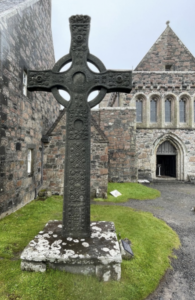
The restored Abbey Church of Iona
The dissolution of the monastery in the mid-sixteenth century was not the end of the story of a religious community being on the Island of Iona. For just short of one hundred years an Ecumenical Community has been established on the Island. The Revd George MacLeod, a Minister of the Church of Scotland serving in Glasgow, founded the Iona Community in 1932. He was a social reformer who was convinced that ‘faith must be grounded in action’. With MacLeod’s drive and the help of trainee ministers and unemployed workers, they undertook the mammoth task of rebuilding the ancient ruined abbey and then re-established an accommodation block to house the embryonic community and visitors who lived, worked and worshipped together. Today there are over 280 members of the Community and more than 2000 associate members, young, adults and friends, all sharing the founding vision of sharing work and living as a community as they pursue justice and peace throughout Scotland and far beyond. For a number of decades now, The Iona Community has resourced Church congregations across many counties with liturgies and worship songs published by the ‘Wild Goose’; these are the result of the worship lived out daily that are at the heart of the community. On my visit, the Island of Iona was quietly busy with many pilgrims from the UK and far beyond who wanted to visit this holy place where, for nearly 1500 years, people have found a place of prayer and spiritual enrichment founded by St Columba.
A Hymn attributed to St Columba
High creator, Ancient
of Days, and unbegotten,
who was without origin
at the beginning and foundation,
who is and shall be in infinite
ages of ages;
to whom was only begotten
Christ, and the Holy Ghost,
co-eternal in the everlasting
glory of Godhood.
We do not propose three gods,
but we speak of one God,
saving faith in three
most glorious Persons