By Emily Chircop
How did Exeter Cathedral become home to so many medical texts? The history of the Cathedral Library collection is connected to the Devon and Exeter Hospital (now the RD&E) and an 18th century physician, Thomas Glass.
Glass was born in Tiverton in 1709 and studied medicine at Leiden University in the Netherlands. He returned to Devon and later moved to Exeter, where he became a founding member of the Exeter Medical Society and was elected president of the hospital in 1785.
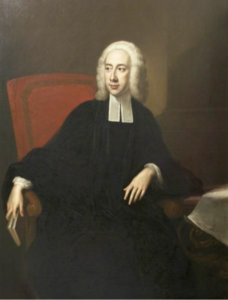 Pictured: Alured Clarke, courtesy of Royal Albert Memorial Museum
The Cathedral and the hospital have always been linked. It was Alured Clarke, Dean of Exeter, who laid the foundation stone for the Devon and Exeter Hospital in 1741 and appointed Thomas Glass as a founding physician of the hospital. It seems fitting, then, that the Cathedral Library would house Glass’ medical collection all these years later. Upon his death in 1786, Glass bequeathed his library of medical books – over 350 volumes – to Exeter Cathedral on the condition that any physician in the city would have access to them. The collection was later loaned to the hospital library and eventually returned to the Cathedral in 1948, where it has since expanded substantially.
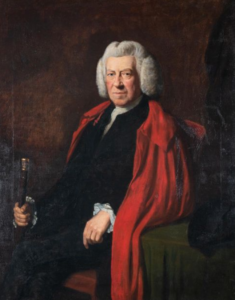 Pictured: Thomas Glass, courtesy of Royal Albert Memorial Museum
In his lifetime, Glass was well-regarded by his peers and was considered an expert on smallpox. His main publication was Twelve Commentaries on Fevers, which explains different types, causes, and treatments for fevers based on the guiding principles of Hippocrates. The Cathedral holds multiple copies of this book, including the original Latin edition with Glass’ annotated corrections and a beautifully gilded copy of the English translation. Handwritten touches in historical books, like Glass’ annotations, make an impression on readers – they reveal the very human process of correcting and learning across the centuries.
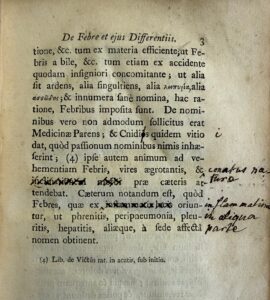 Pictured: Glass annotated his book with corrections to the text.
Thomas Glass’ legacy lives on in the Cathedral Library collection. Today, the medical and science collection has grown to around 3000 volumes, and students, researchers, and the public still consult Glass’ books. Medical practitioners have remained involved with the collections: for the past decade, medical students from the University of Exeter studied these texts in the Cathedral’s Medical Humanities module ‘What Can History Tell Us?’. Most recently, Dr Christopher Gardener-Thorpe generously donated his private collection of publications related to the work of James Parkinson (1755-1824), after whom Parkinson’s Disease is named. Public events like the ‘Medicine in the Making’ Library Tour ensure these historical works can be explored year after year. Glass’ donation formed the basis of the Cathedral Library’s impressive historical medical collection and encouraged public readership at the Cathedral. He would surely appreciate that his books are enjoyed by the public and the medical community to this day.
–––
Further Reading
The Christopher Gardener-Thorpe Collection, Cathedral Life
The History of Exeter Cathedral’s Medical Collection, Cathedral Life