By Emily Chircop
For most of human history, smallpox was a truly devastating disease, spreading rapidly through communities and especially affecting vulnerable children. Up to 30% of people who caught the virus would die from it, and survivors could be left with severe scarring or even become blind. There is evidence of smallpox lesions on Egyptian mummies, suggesting it has affected humans for at least 3000 years, but in 1980 it was declared the only human disease to be fully eradicated. The history of preventing and eliminating this virus can be traced back to the practice of variolation and the work of Edward Jenner (1749-1823) on vaccination.
Survivors of smallpox became immune, so the main method for preventing the disease before vaccines was variolation, also called inoculation. This was practiced around the world for many years and introduced to Europe in the early 1700s. Doctors would take pus from the lesions on an infected person and apply it to small cuts in the skin of a healthy person to prompt an infection. This person would then develop symptoms of smallpox and would be immune from infection if they recovered. Variolation was supposed to cause a milder infection than catching smallpox naturally and it had a much better survival rate, but it was still very risky. Sometimes people would develop a more severe infection, or spread the virus to others, and there was also the danger of contracting bloodborne illnesses.
Edward Jenner, a physician from Gloucestershire, publicised the next step in the fight against smallpox in the 1790s. It was commonly believed that milkmaids were resistant to smallpox, and Jenner’s study provided scientific evidence for their immunity. He found that milkmaids were exposed to cowpox, a milder virus than smallpox which is similar enough to provide protection from it. Other physicians at this time had begun experimenting with vaccination (which takes its name from the Latin word for cow, vacca) but it was Jenner’s study and promotion of the science which led to the spread of the practice.
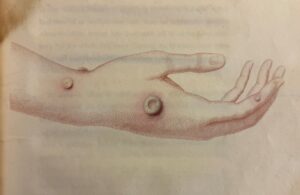 Pictured: The hand of Sarah Nelmes, a milkmaid with cowpox.
Jenner took infectious matter from milkmaids with cowpox and inoculated healthy patients with it. After they recovered, he attempted to infect them with smallpox, but found they had no reaction. This method of using a relatively safe virus to protect people from a deadly virus was the first vaccine. Jenner’s monographs, published in 1798, 1799, and 1800, detail more than 20 cases of individuals being immune from smallpox after a cowpox infection. He also included letters from other physicians documenting their own vaccinations to support his evidence, revealing the community of learning that helped develop this discovery.
The Cathedral Library’s copy of Jenner’s work is the second edition from 1800, titled An Inquiry Into the Causes and Effects of the Variolae Vaccinae. It contains his three monographs bound together, including four rather grisly illustrations of cowpox and smallpox pustules. In the 1810s, the Cathedral Library’s medical collection was loaned to the Devon and Exeter Hospital, where it was used by doctors and medical students before returning to the Cathedral in 1948. Jenner’s Inquiry was added to the collection during its time at the hospital and bears the marks of medical learning from 200 years ago. The pages are annotated with key notes on Jenner’s work in handwriting that appears to be from the early 1800s. Perhaps its reader donated it to the hospital after studying it, or a doctor used it to teach trainees about vaccination – we can only imagine.
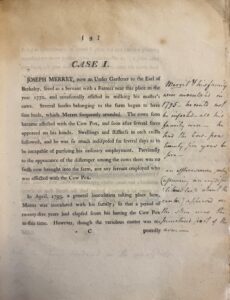 Pictured: Handwritten notes summarising Jenner’s case studies.
In Jenner’s lifetime, his work was greatly praised. Recognising the importance of his discovery to humanity as a whole, he dedicated the rest of his life to vaccination. Jenner hoped his vaccine would help eliminate “the severest scourge of the human race” and the science behind it eventually did eradicate smallpox. Vaccines have become safer through extensive testing and development, and they now offer protection from a wide range of dangerous diseases. Most vaccines use inactivated forms of viruses, rather than a similar live virus like cowpox, so they cannot infect anyone. This progress is the result of centuries of learning and medical development – a process we can chart from variolation, through Jenner’s vaccine, to the doctors studying his work at the hospital, to the generations of scientists who continue to work on new vaccines today.
–––
Further reading
Smallpox, and Jenner, University of Oxford Podcasts Futuremakers series
Edward Jenner and the history of smallpox and vaccination by Stefan Riedel