The Friends' Cloister Gallery
The rectangular area to the south of Exeter Cathedral’s nave was once surrounded by medieval cloisters on all fours sides. Following the requisition of cathedral properties during the English Civil War, the medieval cloisters were demolished in the 1650s. Various properties were later erected in their place on the four sides of the cloister.
During the 19th century many of these later properties were demolished. Houses built between the nave buttresses on the north side of the cloister were condemned and demolished in 1814. Around the same time properties which had been built along the east range, including in front of the chapter house, were also demolished. Between 1819 and 1871, houses occupying the northern half of the west cloister walk were demolished in stages. The last of the cloister houses to be demolished were those at the east end of the south range. They were removed early in 1887 to make way for the new building designed by John Loughborough Pearson which was to house the cathedral’s library on the upper floor. This L-shaped building filling the south east corner of the cloister sits on the foundations of the medieval cloisters and is divided into bays corresponding to the medieval structure.
Pearson’s building was part of a larger scheme to rebuild on all four sides of the cloister. Stonework at the northern end of Pearson’s building was left in place ready for continuation of Pearson’s designs as an eastern range in front of the chapter house. Proposals for additional building work in the cloisters were suggested in 1918 as an option for the Devon County war memorial to extend the library as a public resource. In 1928 and again in 1933, there were further attempts to revive the idea of completing the cloisters but there was no progress.
When Camilla Finlay was appointed cathedral architect in 2012 she was required to develop a new cathedral masterplan which included an appraisal of the properties around the cloister. A fundamental part of Camilla’s plans was a proposal to rebuild the east cloister walk which would reconnect the south aisle of the nave with the chapter house and the Pearson building. It would also provide valuable additional space which could be used for other purposes.
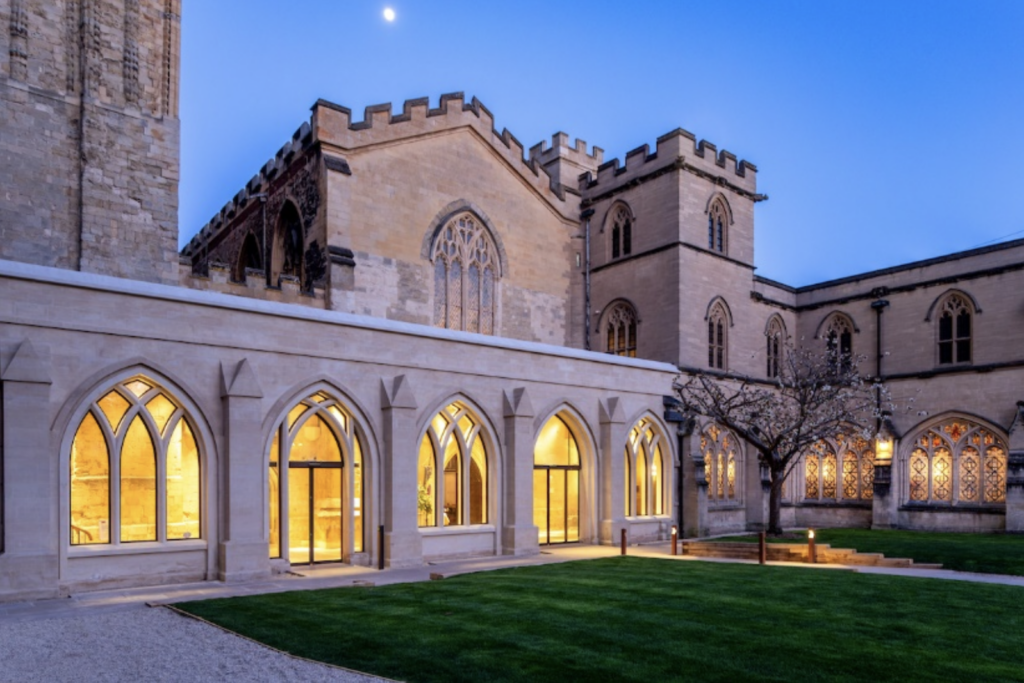
Photo by Andy Marshall
Building the new gallery on the east side of the cloisters has been a significant part of the cathedral’s 2020s Vision Project. Funding was successfully obtained from many sources, including the Heritage Lottery Fund. The generous donation of £1 million from the Friends of Exeter Cathedral is recognised in the naming of the gallery as The Friends’ Cloister Gallery.
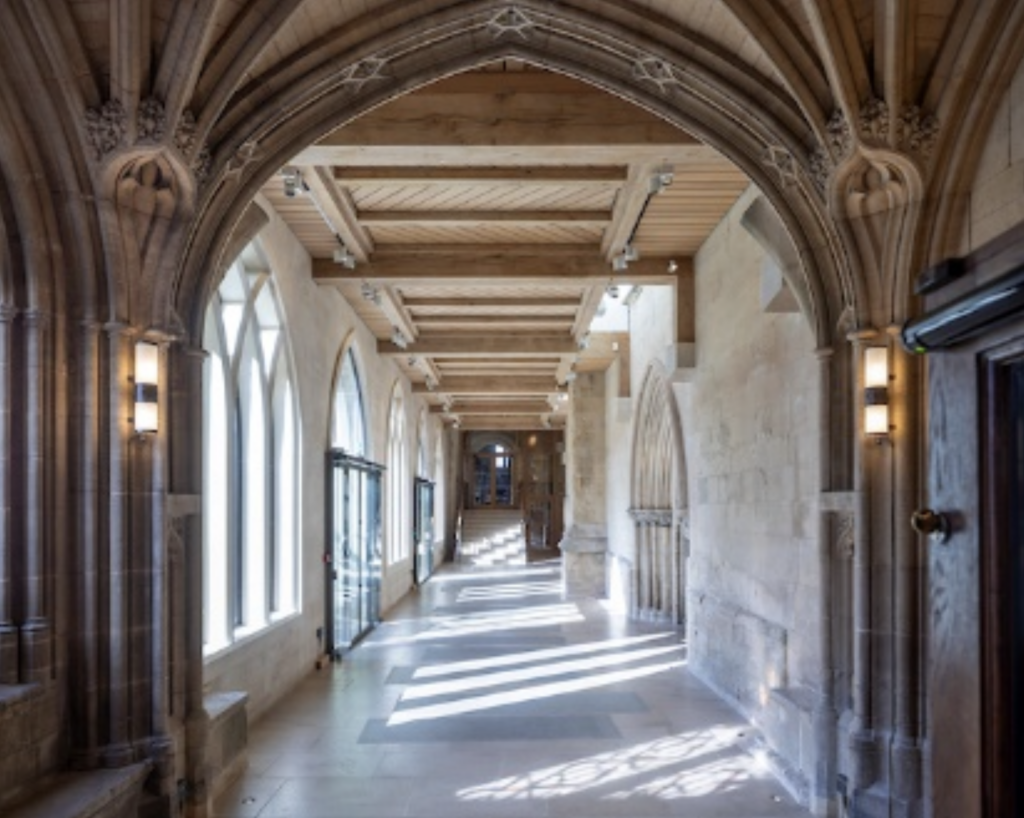
Photo by Andy Marshall