 By Emma Laws, Cathedral Librarian
Charles William Hempel (1777-1855) was an English organist, composer and teacher. Originally from London, he became organist of the 16th century church of St Mary the Virgin, Truro, in May 1804, and supplemented his income composing anthems and melodies for morning and evening services. After forty years as a church organist, Hempel moved to Exeter.
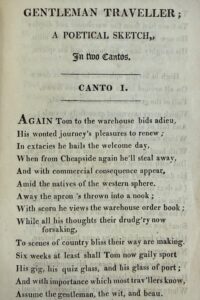
Hempel was also something of a minor poet. His satirical poem, ‘The Commercial Tourist, or Gentleman Traveller’, was published in London in 1822 with engravings by J. R. Cruikshank, brother of the more famous illustrator and cartoonist, George Cruikshank. However, the Cathedral Library has recently acquired by generous donation, the very rare and little known unillustrated edition of the poem, printed in Plymouth in 1817 under the shorter title, ‘The Gentleman Traveller’.
Hempel was a critic of the growing commercialisation of travel in the 19th century. He probably drew on his own experience of inns and taverns in the West Country and so his poem is a wonderful piece of West Country history. Hempel mocked those in the commercial middle-classes who travelled in the guise of ‘gentlemen’, mimicking upper-class manners and dress, but not, so Hempel thought, upper-class morals.
The protagonist, Tom, leaves his warehouse in Cheapside to spend six weeks among the ‘natives of the western sphere’. He plans to ‘assume the gentleman’, armed with a ‘quiz glass’ and a ‘glass of port’. His gluttonous and drunk behaviour, however, are a bit of a giveaway; in fact, he fails to impress two women who immediately see him for what he is: ‘you’re mistaken if you presume Sir that with us you’ll pass for anything but a conceited ass!’
Hempel was a traditionalist at a time when the emerging commercial middle-class was challenging the centuries-old idea that wealth and social status were synonymous with moral values such as decency, honesty, respectability and honour, while poverty was a symptom of weak moral character. (Evidently, Hempel hadn’t read Samuel Richardson’s magnificent 1748 novel, Clarissa, in which a wealthy and predatory ‘gentleman’, Robert Lovelace, aggressively pursues and destroys a virtuous young lady.) Even today, people use ‘gentleman’ to signify someone of good moral character with a nice-guy image. In the old rivalry between Bjorn Borg and John McEnroe, it was Borg who was described as a ‘true gentleman of the game’.
In later life, Hempel left Exeter to return to London where he worked as a bank clerk. Sadly, his final years seem to have been plagued by financial difficulties and he is believed to have died penniless in a Lambeth workhouse. Which makes me wonder – would he have considered his own poor death a moral failure? I hope not.