 By Anne Eyre
It all began when the last designer for the guild had decided she needed to retire. It was clear that we did not need any more kneelers, though they were wonderful and a true record of the birds and flowers of Devon. Someone suggested that we needed to record the Cathedral history and mentioned Bayeux tapestry as an inspiration. The search began and, in time, Marjorie Dyer was commissioned by the Cathedral.
She planned the wonderful design which included the history of the Nation, Devon, Exeter and the Church. She telephoned one day, saying she was looking for a unifying shape to contain the events: during the sermon on Friends Day, I glanced up and noticed the gallery in the triforium. I drew it (sort of!) and emailed it to her. She settled on the rondels to contain the pictures and the narrative. This symbol was already in the Cathedral, ensuring a link with the existing decoration which she desired. The period that she researched stretches from Roman times, circa AD 300, until the visit of Queen Elizabeth II for the Royal Service on 31 March 1983.
This project could never have been achieved had there not been the Company of Tapisers already in existence. That society started in the time of Dean Gamble. Mrs Gamble, an energetic woman from all accounts, who had a considerable acting career too, began this work. They used to meet in the South Quire Aisle, and I think I am correct in saying their first project was making a carpet for a chapel. The range of work has grown over the years making ceremonial vestments, banners, the white work, the linen articles used during the celebration of the Eucharist, repairs, and canvas work. This work still continues ably – led by Diana Symes, who has the pre-eminent skill and a huge range of specialist knowledge. This Company is part of the history and tradition of this place.
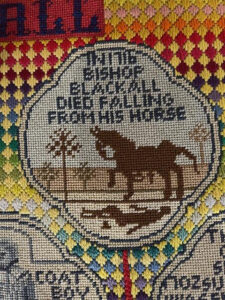
All was in place to start the making of the Rondels. Two rooms at the back of the Old Deanery were allocated to the Tapisers; one for keeping all the materials, and the other as a workroom. There was a tiny kitchen for necessary refreshment. There followed a meeting in the Chapter House, attended by 100 people and eleven signed up. Marjorie Dyer was not dismayed but commented “that she would probably not see it complete.” I am uncertain whether that affected her design, but in a very short time she had the overall pattern in place. This work was going to become a reality; “while relating to the medieval building, the design was going to be modern in conception and simple enough to be understood by the majority of visitors. It needed to be both colourful and suitable for its surroundings.” The basic design fulfilled that simplicity: the top of the cushion has the dates of every bishop, below a series of rondels contain the events of the time, along the lower edge the coins of every King of England (copies of coins from the British Museum) and the dates of their reigns, and the deans are on the drop down piece, surrounded by patterns that are all historically appropriate. Marjorie spent hours in the Cathedral, living with the feel of the place, imbibing the vast history still alive in it, with all its varied detail. She started by making designs for some of the Chapels to imbibe the place.
She was given a huge amount of white thread; this runs down the middle of every section; for Marjorie this was the life of the Holy Spirit through the ages. The bright colours of the background make it visible throughout the Cathedral. She recorded over 14 million stitches on graph paper, with codes for colour and stitchery. I am reminded of the fact that Handel wrote the Messiah in ten days – exceptional inspiration. The work was managed by the then Chair of the Exeter Cathedral Company of Tapisers, Mrs Jo Brandling Haris.
Beyond and within her talent and gifts, Marjorie was a woman of great faith – the Cathedral is a place of long faith. The Lord’s Prayer appears twice; once in Latin before the reformation, and later once in English. Spaced over the length of the cushions, the Te Deum bursts as a song of thanksgiving and praise in large red letters. The stories told are part of a long story of humanity, of history and of faith. She wished to celebrate all of it.
She kept the choice of stitches comparatively simple, in recognition of the size of the project, and the large number of people who soon realised that they needed to be a part of this great work! The stitches used are:-Tent stitch, Cross stitch, Long-armed Cross stitch, Rice stitch, Diagonal Parisian stitch, Eyelet stitch, Straight Gobelin stitch, Gobelin (Gros Point) and, for the background, Hungarian Satin Stitch. The Paternayan Persian wool in 73 colours had to be reduced from three stranded to two stranded. There was a team of volunteers for that part of the work. The dedication and hard work of those 68 women needs to be celebrated as well,
At last, in 1987, the end was in sight – but first, the Company of Tapisers had to face the difficult task of joining various pieces together so that the upholsterer could complete the final stitchery. The Cathedral at the time had a theme for each year and 1988 was to be a year for the Arts. Marjorie felt they could manage to finish in time to celebrate the installation of the Rondels. A special service of dedication was arranged, the Lord lieutenant declared the Rondels open as part of the glory of the Cathedral. There had been 68 workers on this project. Every member was there. We remembered the three who had died during the five years and we celebrated this amazing work.
We need to continue to respect, care for them and celebrate them now, and to admire the very special work of Marjorie Dyer.
There is another reason, too, that these need to be conserved properly. The Company of Tapisers have embarked on a series of cushions recording the events during the time of the last five Deans, based on the designs of the Marjorie Dyer work. These will adorn the back two bays at the West End. They are going to be a splendid continuation, and completion. I am sure that Marjorie Dyer would be thrilled.