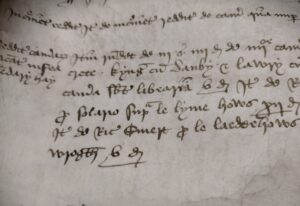
 By Ellie Jones, Cathedral Archivist
What does this extract from an account roll dating from 1463 have to do with carols? It makes reference to Richard Smert, one of a small handful of identifiable medieval musicians known to have composed carols.
Carols were hugely popular in late medieval England. They were secular and religious songs, written and performed by professional musicians, that had developed from twelfth-century French courtly dances. Medieval carols were not as closely associated with Christmas as they tend to be today. There were (and are) devotional carols for Easter and saints days too, and some were humorous, political or satirical in nature.
Despite their popularity, we know little about the early composers of carols. Only a few names are known, and details about their lives are scant. We do know something about two key composers though: Richard Smert and John Trouluffe. Smert was born around 1400, appointed as a vicar choral at Exeter Cathedral in 1427, and he was vicar of Plymtree from 1435-77. Trouluffe, the younger of the two, was appointed 20 years later. Both were appointed by Bishop Edmund Lacy, a patron of music. They are both documented as members of Exeter Cathedral choir for an extended period, placing them firmly in time and place and confirming them as professional musicians rooted in a particular musical tradition. They would have sung together regularly in the Cathedral choir and it is clear that they worked together on a number of carols.
Sadly, their original compositions are no longer at the Cathedral but can be found in the Ritson Manuscript at the British Library (where it has been since 1795). The Ritson Manuscript is a choirbook written over a period of several decades in the second half of the 15th century, and likely originating at Exeter Cathedral. It contains 44 carols – about a third of all known English medieval examples – mostly composed by Smert and Trouluffe.
This carol by Richard Smert is known as “The Exeter Boar’s Head Carol”:
Original text
Nowell nowell nowell nowell
tydynges gode y thyngke to telle
This borys hede we bryng with song
in worchyp of hym that thus sprang
of a virgine to redresse all wrong
nowell nowell.
Modern text
Nowell, nowell, nowell, nowell:
tidings good I think to tell.
This boar’s head we bring with song
in worship of him that thus sprang
of a virgin to redress all wrong:
Nowell, nowell.
You may not hear traditional carols like this one at every Christmas concert this season but keep an ear out because they are still performed and recorded nearly 600 years after they were first composed.
–––
Photo: the 15th century composer of carols, Richard Smert, pays his rent on ‘the larderhouse’