 By Ian Morter, Priest Vicar
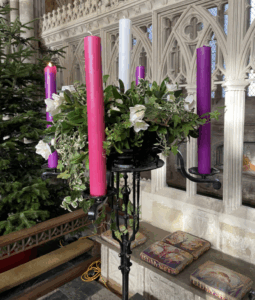
During this past week, in the Quire of Exeter Cathedral by the High Altar, our Advent Wreath has appeared. It is difficult to miss as it stands over five feet tall. You can see from the photograph that it is made up of five candles, in a circle of greenery. It is the means by which we count up the four weeks of Advent and then greet the celebration of Christ’s birth with the fifth candle at the centre.
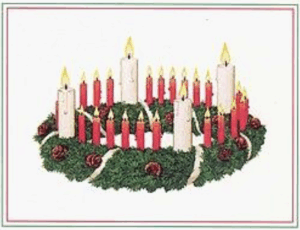
The tradition of the Advent Wreath goes back to the 16th century and originated in the Lutheran Church. But it was not until 300 years later in the 19th century that it truly took root as a result of a pastor and chaplain to a school in Hamburg where he introduced it as a teaching aid. The Revd Johann Wichem (who died in 1881) founded the social mission school called the Rauches Haus, a place where children of the poor could be educated. The story goes that, in the winter of 1839, every day the children in the school would ceaselessly ask when Christmas would arrive. So taking an old cartwheel, he decorated it with greenery and then fixed on it four large white candles that were interspersed with six smaller red candles, making a total of 30 candles. One of the small candles would be lit every weekday, and then on the Sundays one of the white candles. The children were able to anticipate the feast of Christmas – the birthday of Christ.
The custom rapidly gained popularity in the Lutheran Church and by the mid-twentieth century it was to be seen in England. In 1964 the Children’s BBC programme Blue Peter adopted the idea, lighting a candle for each of the four programmes before Christmas. In good Blue Peter fashion, the presenters Valerie Singleton and Christopher Trace showed their young viewers how to make their own Advent Wreath by joining together two wire coat-hangers decorated with tinsel and a candle on each of the four arms. There was of course the injunction, “now children, remember to ask an adult to help you light the candles”. It was in the later 60s when I became a teenage Sunday School teacher at my parish Church, St Barnabas Walthamstow, that I made our first Advent Wreath from the cart-wheel of the Scout Troop’s hand cart and four large altar candles borrowed from the sacristy, all decorated with holly and leylandii.
The Advent Wreaths of today are much more sophisticated. Church suppliers now have provided special stands which can be decorated with greenery and holders for the five candles that are used for the ‘count up’ to Christmas day. The original white candles have been replaced with three purple and one rose-pink, the colours of the liturgical vestments of the season, with the central ‘Christmas Candle’ being white, representing the light of Christ in the midst of us. I have sometimes been asked ‘why the rose-pink candle’? The third Sunday of Advent is often called ‘Gaudete Sunday’ – a day of joy that comes from the Latin for ‘rejoice’, reminding us of the joy of anticipating Christ’s birth. The four candles have also been given ‘names’ of the four Christian virtues: hope, peace, joy and love. The circle and greenery of the wreath represent the eternal love of God and the hope of everlasting life brought through Jesus Christ.
In the Church of England, during the last decades of the 20th century with the liturgical developments, prayers have been provided to be said as each of the candles are lit. These reflect the Advent Sunday themes: The Patriarchs, The prophets, The Forerunner – John the Baptist and The Virgin Mary – the mother of God.
The prayer for the second Sunday of Advent (7 December) as the candle is lit:
God our Father, you spoke to the prophets of old of a Saviour who would bring peace. You helped them to spread the joyful message of His coming Kingdom. Help us as we prepare to celebrate His birth, to share with those around us the Good News of your power and love. We ask this through Jesus Christ, the Light who is coming into the world. Amen.
Perhaps, like me, you prefer the count up of the Advent Wreath rather than the now ever popular Advent Calendar with its secular themes and chocolate treat behind each door, but perhaps it is just the ‘bar humbug’ of Dickens’ Ebenezer Scrooge coming out in me!
Enjoy your Advent with the riches of the themes of the Scriptures and Hymns of anticipation and the variety of Advent services.