By Emma Laws, Cathedral Librarian
The word ‘sampler’ comes from the Latin ‘exemplum’, meaning example. In the 16th and 17th centuries, proficientneedleworkers created samplers to record the different stitches, patterns and devices to use in their sewing. Even when printed pattern books became more widespread, needleworkers still largely relied on samplers to create and communicate their repertoire of skills.
Samplers gradually evolved from working reference tools to educational resources, typically for young girls learning to sew. There were two principal types: ‘spot’ samplers featured motifs and patterns positioned freely or even randomly across the fabric while ‘band’ samplers displayed an orderly arrangement of repeating motifs in rows.
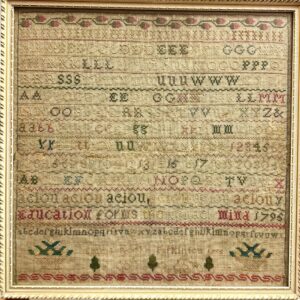
By the 18th century, samplers were typically square-shaped and framed to display on a wall. This lovely sampler, made by seven-year-old Emma Rook Parkinson (1788-1867) in 1795, is characteristic of the sort of cross-stitch work produced by a young girl at the end of the 18th century. Worked in coloured silks on linen, it includes letters (upper and lower case), numbers, decorative borders, and pictorial motifs, including acorns and baskets of flowers. Samplers usually incorporated didactic, moral or religious maxims, such as, here, ‘Education forms the tender mind’.
Emma Rook Parkinson was the eldest daughter of James Parkinson (1755-1824), author of the ground-breaking 1817 essay on the shaking palsy, the neurodegenerative disorder known today as Parkinson’s Disease. The sampler is among the items generously donated to Exeter Cathedral Library by Dr Christopher Gardner-Thorpe in September 2025.