 By Emma Laws, Cathedral Librarian
Richard Rolle was a 14th century English hermit, mystic and prolific religious writer. Although he was never canonised, the Church of England commemorates him on 23 January. Regulars at Choral Evensong won’t be surprised to hear that one of Richard Rolle’s earliest mystical experiences occurred while listening to a choir – and he continued to hear music from heaven whenever he chanted the Psalms. He wrote of two other forms of mystical experience: a feeling of physical warmth and a sense of sweetness. His experiences contributed to the medieval practice of affective meditation, initiated by St Anselm of Canterbury, in which Christians imagine the sights, sounds, smells, tastes and textures of events in the Gospels.
Richard Rolle wrote in Latin and English from around 1340 until his death, possibly of the Black Death, in 1349. We know his works were popular in the 14th and 15th centuries because copies of his treatises exist in hundreds of English and Continental manuscripts. In fact, more manuscripts exist of his works than of any other medieval English writer, including Chaucer.
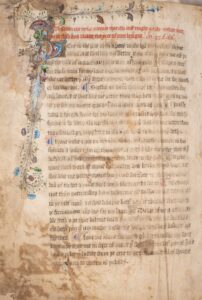
Bound in at the back of the 15th century Fortescue Book of Hours, currently on display in our Treasures Exhibition, is a beautifully illuminated copy of a treatise in English by Richard Rolle, dated 1345: ‘These ben the nyne vertues that Jhesu Christ taught a sely creature that was in flesh and bloode the yeer of oure Lord God MCCCXLV’. The treatise alludes to the nine fruits of the Holy Spirit in Galatians 5:22-23: love, joy, peace, forbearance, kindness, goodness, faithfulness, gentleness and self-control. Richard Rolle’s rhetoric is musical, full of imagery and poetic devices such as alliteration, rhythm and repetition. He balances each statement with the refrain, ‘and it shal like me better than if …’:
Yeue [Give] to the pore man a peny in thi lyf that is freili [freely] thyne own and it shal like me better than if thou yeue [give] me after thi day the hill of mountain tho it were all fine gold’.
Richard Rolle was especially influential in the north of England but his mystical writings lost favour following the Reformation, which sought to replace mystical experience with faith grounded in scripture. Objects of affective meditation were systematically destroyed, including images, crucifixes, sculptures, and even liturgy and music. Books of Hours, many of which may have preserved copies of Richard Rolle’s works, were also banned and burned. Fortunately, the Fortescue Book of Hours – with its precious copy of Richard Rolle’s treatise on the nine virtues of Christ – survived.
Click here to plan your visit to our Treasures Exhibition – the home of the 15th century Fortescue Book of Hours.