By Canon Ian Morter, Priest Vicar
We are in Easter Week – a time of great rejoicing as we celebrate the Resurrection of our Lord. The Easter celebration is one of the most joyful times of the year for all Christians and our celebrations go on for 40 days until the Ascension. Over the weeks, we hear of the times when the risen Lord Jesus appeared to his disciples and many other followers. As I read them, it has occurred to me that three of them are very domestic in their nature. The appearance at the garden tomb, the supper at Emmaus, the breakfast on the lakeshore.
Two of the appearances conclude with a meal – the exception is the first appearance, and perhaps the most profound, that to Mary Magdalene at the garden tomb, but it is nevertheless domestic. Here is the risen Lord Jesus in a garden mistaken for the gardener – perhaps it is my Englishness, my love for gardens, that makes me understand this as a domestic occasion.
The other two are set in the context of a shared meal with Jesus and to those to whom he appeared. The sharing of food, the giving and receiving hospitality, are stories common in both the Old and New Testaments. And if we focus on the four Gospels we read that the domesticity of sharing food was one of the characteristics of Jesus’ ministry and teaching. So, I should not be surprised that three of the ‘resurrection appearances’ were domestic, occasions in a garden and over meals of breakfast and supper.
In the first of the recorded resurrection appearances in St John’s Gospel 20:1-18, Mary Magdalene goes to the Garden of Gethsemane and the tomb where Jesus was buried is empty. Having reported this to the disciples, she returns to the tomb to encounter the risen Jesus who Mary mistakes for the Gardener. She asked if he has moved the body and, if so, where Jesus’ body had been taken. The supposed Gardener greets Mary by her name. Instantly she recognises Jesus and tries to embrace him. But Jesus says to Mary ‘Do not touch me’ but go and tell my disciples that you have seen me.
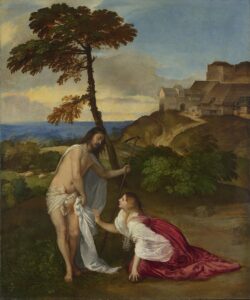
The painting here was completed in 1514 by the Titian and is entitled Noli me tangere ‘Do not touch me’ and can be found in the National Gallery in London.
It is by Italian Renaissance painter Tiziano Vecellio, known in English as Titian. He was the most important artist of Venetian Renaissance
The second appearance I would like to speak about is by the Sea of Tiberias – St John 21:1-14. Seven of the disciples decide to go fishing. At day break Jesus appears on the beach unrecognised by the disciples. He calls to them to ask if they had made a catch during the night. When they report that they had not been successful, Jesus suggests that they cast their net again. They make the most amazing haul of 153 fish. Peter then recognised Jesus and jumps overboard to swim ashore to greet the risen Lord. When the other disciples then reached the shore, they find that Jesus has lit a charcoal fire and was cooking fish and bread for breakfast and invites them join him.
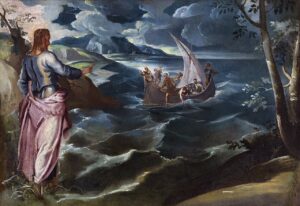
Christ at the sea of Galilee painted by the Dutch artist Lambert Sustris about 1570. Having moved to Venice he worked in the studio of Jacopo Tintoretto. In the collection of The National Gallery of Art, Washington DC.
The third of the Resurrection appearances takes us back to Easter day. It is the account of the walk from Jerusalem to the village of Emmaus. St Luke 24:13-35. Two of the followers of Jesus were returning to the village and were joined by a stranger on the road. They were discussing the things that had happened over the last few days in Jerusalem. When asked by the stranger what they were speaking about, they were surprised that he did seem to know about these events. They in brief speak of the ministry of Jesus and their hopes that he was the Messiah, but he had been arrested and put to death three days earlier. But the stranger then goes on to explain to them about the Old Testament reference to the Messiah as the suffering servant who would be vindicated by God. As the journey progresses, they reach Emmaus and press the stranger to join them for supper. It is at the table that Jesus breaks the bread and they recognised the risen Lord Jesus, who then disappears from their presence. They return that very evening to Jerusalem to share with the disciples that they had seen the Risen Lord.
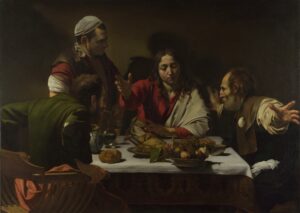 The Supper at Emmaus. Painted in 1601 by the Italian artist Michelangelo Merisi da Caravaggio. A great exponent of chiaroscuro light and shadow painting. – National Gallery London