 By Ellie Jones, Exeter Cathedral Archivist
Many people across Britain are looking forward to the long May Day holiday this weekend. Although 1 May is a public holiday in other parts of Europe, in Britain, the May Day bank holiday occurs on the first Monday of the month and was established as recently as 1978. Spring festivals, however, have been taking place at this time of year for millennia, and you may have a chance to enjoy some in your local area
In ancient Rome the Floralia was a celebration of the goddess of fertility, flowers and spring, Flora. In Celtic and Gaelic-speaking countries Beltane celebrations are known from at least medieval times. In Wales, Calan Mai (first of May) is a long-established tradition featuring bonfires and singing. In Germany and elsewhere in northern Europe, Walpurgisnacht (Saint Walpurga’s night) takes place on the night of 30 April-1 May and commemorates Saint Walpurga (an 8th century, Devon-born Christian missionary to Germany). In some towns in Austria and Germany, the Maibaum (May tree) – a massive, straight tree trunk adorned with wreaths and ribbons – is raised with hours of communal effort and no machinery. It is less common now, but some of us may remember maypole dancing at primary school fetes (the custom was certainly alive and well in mid-1980s Berkshire), attempting to dance in sequence and weave the ribbons in and out and around the maypole without getting into too much of a tangle with our schoolmates!
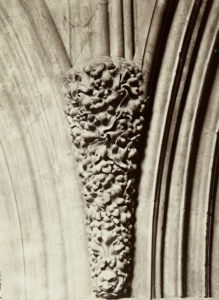
Last weekend, here in Devon, it was the Bovey Tracey Green Man Festival, a joyful celebration with many Morris dancing sides coming together to welcome in the spring in the company of the Green Man himself. The Green Man wears a costume of leaves, which is defoliated by festival-goers at the end of the day. Watching the spectacle, it was hard not to be put in mind of the dozens of foliate heads carved around Exeter Cathedral. The Cathedral has a particularly fine collection of these carvings, including nearly 40 in stone bosses and five in wooden misericord seats. Most are medieval, but there are later examples too, some are brightly painted and some are now plain. Each one is unique.
The term “green man” used in the context of architectural is a modern term, credited to Julia Somerset, Lady Raglan, in her article “The Green Man in Church Architecture,” published in the journal ‘Folklore’ in 1939. These heads, with foliage surrounding them, usually with leaves and branches sprouting from their mouths, are especially common in medieval British churches but also appear elsewhere in northern Europe. Although their symbolism and origins are debated, they are commonly believed to represent symbols of resurrection and new life.