 By Anne Eyre
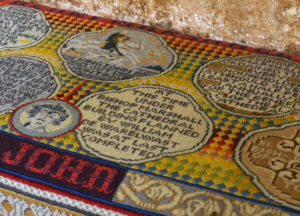
It was my job in 1981, as Chair of the Tapisers guild, to find a new designer for the canvas work upon the retirement of Mrs Lockwood. I was passed from one person to another until the day when someone said “Have you tried talking to Mrs Dyer?”. She and her husband came to lunch at the Old Deanery. We discovered many common friends. More importantly, we learnt that we had been talking to a serious and talented artist. We had explored with her the possibility of these cushions being a memorial to the history of Exeter and its Cathedral.
She was born in Edinburgh in 1911, educated at Wimbledon High School. She trained at the Wimbledon School of Art and the Slade. At the same time, she went to evening classes in embroidery and design. She had the London university Diploma in Fine art, followed by teacher training. She had won two prizes for design at the Slade and one for calligraphy. She had become a significant student and in the opinion of her professors, this great talent “was going to waste up the Irrawaddy River, with no outlet for this significant talent”. She was later to become a member of the Society of Designer Craftsmen.
It does not take much imagination to understand the dismay of her teachers and colleagues when she decided to marry Harold Dyer, a missionary priest, working up the Irrawadday River in Burma. Her husband wrote “She came out to marry me in 1938 and was thrown in the deep end. Our first married home was a bungalow in the middle of the Irrawaddy Delta. In that location she had to learn the language, there being no English-speaking folk there, learn to paddle and sail our canoe. The river rose some twenty feet and for two months a year we had two feet of water under the house which was on stilts. There were no roads… She was the first married woman of the mission to live out there.” They had two children there. Nevertheless, she was an artist and her work continued there.
1942 changed everything. The Japanese invasion meant they were evacuated; Marjorie left on one of the last planes, with one son aged ten months and a daughter aged two, and 30lbs of luggage. All her artwork had to be left behind. Harold had to walk to escape, by a route euphemistically called “the Great Trek”. Marjorie kept herself and her two children alive in India by selling her drawings and portraits. Harold took 6 months to reach India and to find her and the children. He was dangerously thin and had related health problems for the rest of his life.
Nevertheless, in 1947 they returned to Burma. Harold was put in charge of Rangoon Cathedral. Marjorie was much involved with that, designing a lectern, an aumbry door and a vast hanging Cross. Ill health brought them back to England in 1948. Harold continued his ministry as a parish priest.
Their ministry to Rangoon was not finished. Marjorie was asked to do the Book of Remembrance on the Burma campaign; she lettered some 11,000 names on vellum. This was presented to Sir Antony Eden at a service in Westminster Abbey, where it was exhibited. They were commissioned to take it back to Rangoon.
Her life-long dedication to her art continued. There are works of art in most of the churches where her husband served. Many portraits exist. She continued to teach and exhibit. Her work features in a book by Constance Howard, ‘20th century embroidery in Britain’. For some 15 years after her husband retired she lectured and tutored in Art and Design to adult groups in the West Country. She held two one-woman shows at Dillington House. She was a member of the Society of Designer Craftsmen, the Somerset guild of Craftsmen and the Embroiderers’ Guild.
It was from this place that we successfully had her consent not only to design the Rondels, but to do all the research, too, for a mere £500 a year. How we are indebted. She was 72 years old. It must have taken all her courage to accept this request. I am sure that Harold encouraged her. At last there was a commission to honour her talent.
It was only at the end, six years on, when she had agreed that the opening of the Rondels would be the central part of a year for the Arts, that it was decided to nominate her for an MBE, and I wrote to Harold for a broader perspective of her life. Now we learnt that she had been thrice honoured by the Slade for the supreme quality of her work. We were successful and, to our surprise, Harold persuaded Marjorie to collect her honour from Buckingham Palace with Jo Brandling Harris, who had chaired the whole project. The Dean and Chapter had given Marjorie an exhibition, and sale of her work in the Chapter house, to celebrate this great talent to which we were so indebted.
We had a grand day; the Lord lieutenant Lord Morley officiated. The whole Dyer family gathered and had a memorable lunch together. They returned home to discover that there had been a storm. They were keeping an eye on a neighbour’s house, which had been flooded. In spite of the wonderful day, in spite of their age, they set to and cleared it up before resting and returning home for supper. Marjorie told Harold that she would just go back upstairs and put on a dry skirt. She came down and found that Harold had died peacefully in his chair. I am sure that he felt his work was done, that Marjorie had been appropriately honoured at last.
I had a conversation with Marjorie that evening. She was going to come and do her exhibition. The project finished with both of them working together, for and with each other, for everyone else and, supremely, for their God. Laus Deo.