 By Canon Cate Edmonds
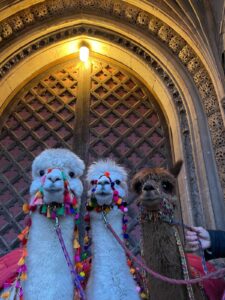
These three adorable creatures – alpacas Mario, Hero and Noah – added to the excitement of the Exeter Nativity last Sunday, when nearly 700 people turned up for the annual live production. The alpacas accompanied the Magi – camels are rather difficult to acquire in this part of Devon!
So what attracts people to a nativity, you ask? Is it just the tradition, something to do with the children on a dull Sunday afternoon, or something else? Many who attended did not have children with them, so what was the pull of the Nativity? I frequently ponder this when walking through the Christmas Market on the Cathedral Green; people stop and gaze at the Nativity scene in the shed, and even take photos standing beside it. But what is the attraction?
I like to think that it is the open arms of the Christ Child welcoming all and sharing God’s love. Whether those who randomly gaze at a Nativity scene can feel that welcome and love, we won’t know, but we pray that their gaze on this special scene will have affected them in some way. That something may have stirred them. But what? Is it just a cute scene, or are the open arms of the Christ Child reaching out in welcome and love, touching, or even stirring, something in those who pass by or gaze on the scene?
In many Nativity scenes, there is light shining from the crib. The painting on the south wall of the nave entitled “The Nativity”, which is attributed to the Dutch painter Gerrit Van Honhurst (1592-1656), is a fine example. The scene is dark but the Christ Child is shining out light, reminding us of those words in the wonderful reading from the first Chapter of John’s Gospel that we hear several times during this Christmas season – verse five; “The light shines in the darkness, and the darkness did not overcome it.”
The message is uplifting when we are in dark times, when we feel the darkness overwhelming us through grief, hardship or illness. But also a light which shines to lead us onward, a light which can be behind, above and before. The light of Christ which does not go out even in death.
I came across this poem, sadly I cannot find who it is attributed to, but it sums up these thoughts so well:
–––
The Light in the Winter Dark
In the hush of frost-bound night,
when the stars are brittle with cold,
a single flame blooms in the manger’s straw—
not of wax, but of living gold.
It spills through the stable’s shadow,
touching the rough-hewn beams,
and shepherds kneel in its radiance
as if waking inside a dream.
This Light is not bound to December,
nor to garlands, bells, or snow;
it burns in the hearts that welcome Him,
wherever His mercy will go.
So let candles fade and fires grow dim—
still, no darkness can take His place;
for Christ is the dawn in the world’s long night,
the Light that is full of grace.
–––
The light above the alpacas in the photo illuminates them, and the light of the carried star led the Magi procession in our Nativity. Those lights were extinguished, but the light of the Christ Child, as the line in the poem states, is not human made but of ‘living gold’.
May that light of living gold continue to draw onlookers of Nativity scenes towards it and may that light shine on us all in this season and forever more.