By Ellie Jones, Cathedral Archivist
This month’s In Focus event “Women’s Work” is taking place on Monday 9 March in celebration of International Women’s Day and Women’s History Month. It is a look at some of the overlooked roles occupied by women in the Cathedral’s employment history.
It was not until 2014, when Revd Canon Anna Norman-Walker was installed as Canon Chancellor, that we had a female Chapter Canon. This was the same year the Church of England adopted new legislation that would allow the first female bishops, 20 years after the first women priests were ordained. Prior to this, the clergy of the Cathedral had all been male – but not the rest of the staff.
More work needs to be done to uncover the stories of the women working with and for the Cathedral during the medieval period, but account books in the Archives give us examples such as the unnamed laundresses employed in the early 14th century, and the embroiderers and seamstresses who have been maintaining the vestments since at least the 16th century.
Our knowledge of female employees is much stronger for the 18th & 19th century. This is partly due to the nature of the workforce, but also because of how the records have been kept. By the mid-18th century, Chapter Act Books, Fabric Books, letters and testimonials all help us to identify the female blacksmith, plumber, chimney sweeps, booksellers, wine merchants, painters, slaters, hassock suppliers, hatters, window glaziers, churchyard weeders and others – including Mrs Adams, a virger in the 1820s. Frequently, but not always, these women had been appointed to carry on the trade of their late husbands, either running the family business and employing others to carry out the work, or carrying out the practical labour themselves.
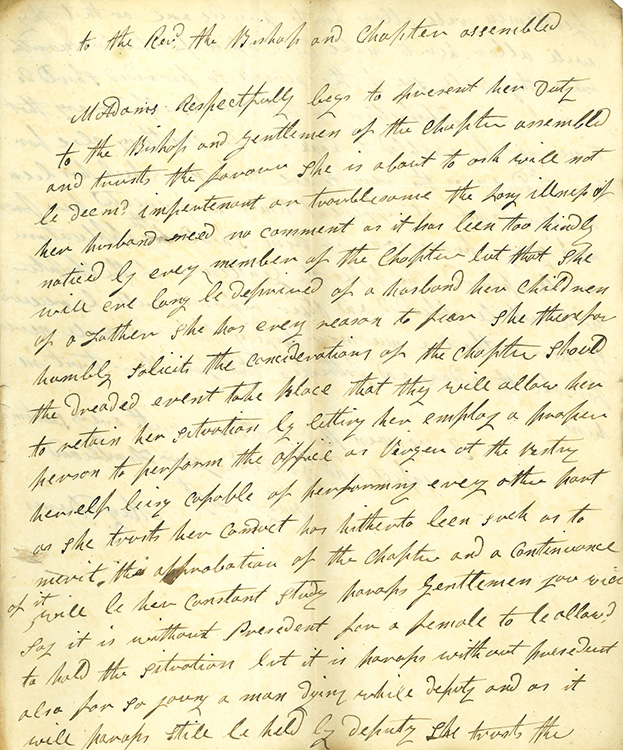
In December 1822 Mrs Mary Adams submitted a heartfelt petition to the Dean and Chapter, anticipating the death of her husband, Richman Adams in which she “humbly solicits the consideration of the Chapter should the dreaded event take place that they will allow her to retain her situation by letting her employ a proper person to perform the office as virger at the vestry herself being capable of performing every other part”. She acknowledges “Gentlemen you will say it is without presedent for a female to be allow’d to hold the situation but it is paraps without presedent also for so young a man dying while deputy”.
When Mr Adams died, aged 37, early the following year, Mary was employed to “act in his place, with the assistance of Charles Reynolds, dogwhipper. Reynolds to find suitable deputy as dogwhipper, when required”. On 30 November 1826 she remarried at the Cathedral, to Joseph Thomas Pickman, an architect, and retired from her role as virger. James Manley, with whom she had shared duties, was appointed virger. The Pickmans left Exeter for Regents Park, London. She died in 1866, aged 79.