By Ellie Jones, Cathedral Archivist
On Tuesday 28 January 1817 at 2pm, the Prince Regent (the future king George IV) addressed the opening of Parliament, left, and the House of Lords retired for the afternoon. The House was to gather again at 5.00pm to hear an address to the Prince Regent in answer to his Speech. When they reconvened, Lord Sidmouth informed the House that he “had one of the most important communications to make to them, that had ever been made to parliament”. The Prince Regent’s carriage had been attacked by a mob as he left Parliament.
The Prince Regent was not popular among the people, his extravagant lifestyle and perceived low morals were at odds with a country experiencing significant social, economic and political troubles, hastened by years of war with France, bad weather and poor harvests. The attack on the Prince Regent was one of many significant riots and acts of protest calling for political reform which took place in England during the 1810s. The passing of severe “Gag Acts”, including the Seditious Meetings Act were a direct result of the attack. These banned meetings of more than fifty people without the prior consent of the magistrates and controlled the printing and dissemination of seditious and blasphemous material.
A few days after the attack, on 4 February 1817, the Cathedral’s Chapter Clerk, Ralph Barnes, followed official protocol in writing to the absent Chapter Canons about the intention to prepare a Loyal Address to the Prince Regent. A Loyal Address is a formal letter sent to the monarch to mark major occasions and, in this case, to express sympathy and loyalty following the attack.
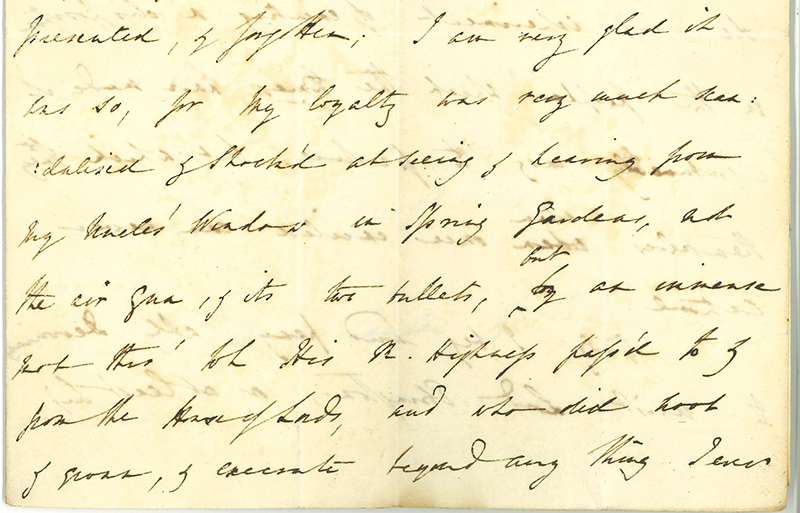
Ten days later Barnes received a reply from Revd George Martin, who had evidently been in London at the time and witnessed some of the events:
“…my loyalty was very much vandalised and shocked at seeing and hearing from my Uncle’s windows in Spring Gardens, not the air gun and its two bullets, but an immense riot…His R Highness pass’d to & from the House of Lords and who did hoot and groan and execrate beyond any thing I ever heard in my life. I think tho’ upon the whole it has done good in the country…”
The letter also mentions Sir Francis Burdett (an MP and political reformer who campaigned for universal male suffrage) and Martin’s hopes that the incident will “open the eyes and wake the ears of many more moderate reformers, who have not been unwilling to resort to the dangerous experiment of exciting a disposition in the people which the times have made it unfortunately easy to produce, but which they themselves when once excited can never control”.