By Canon Ian Morter, Priest Vicar
In the secular world in the late 19th and 20th Century we have seen that women have increasingly, and quite rightly, had influence upon society. In the Western Church, from early times we can see that they have been important because of their influence and development of the Church‘s spirituality and teaching.
This coming week, on 10 February, the Church celebrates the life of St Scholastica who lived in the early to mid-sixth century. She founded the women’s Order of the Benedictines which is an Enclosed Order.
Scholastica was born in the Umbrian City of Nursian, the twin of Benedict who was the founder of Western Monasticism with the Benedictine Order. They were the children of wealthy parents and we understand that the two children were brought up together and shared the same educational tutor, until Benedict left home to study in Rome. As a young woman of her social standing, Scholastica would have remained in her Father’s home until her marriage. From an account of her life which was written just after her death in AD 543, we understand that from an early age she consecrated herself to God as a virgin. From this biography, we understand that she established a hermitage with a number of other consecrated virgins about five miles from Monte Cassino, this was the first convent of Benedictine Nuns. The convent was thought to be a cluster of houses where the ancient church, known as the Monastero di Santa Scholastica, stands to this day.
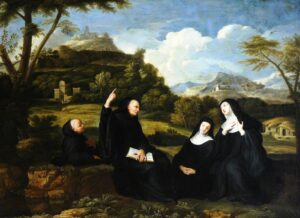
In the writings that spring up after the death of any saint there are stories, sometimes called legends, but their accuracy can’t be proven. One of the most popular concerning Scholastica also involves her twin brother Benedict, and tells that once a year she would visit her brother at a guesthouse near his Abbey. They would spend the day in prayer and discussing scripture and other religious writings. On one such visit, towards the end of her life, their conversation continued over supper and the time came for them to go their separate ways. Benedict said it was time for him to leave. Perhaps Scholastica sensing that this would be the last time they would meet asked him to stay with her for the evening so they could continue their discussions. Not wishing to break the rule he had written for the community, he declined, insisting he must return to his cell, at which Scholastica closed her eyes and brought her hands together in prayer. After a few moments, a wild storm started outside the guesthouse where they were meeting. Benedict, rather shaken by this, asked, “What have you done?” to which his sister replied, “I asked you to stay but you would not listen so I asked God, and he did listen. So now go off, if you can; leave me and return to your monetary”. In fact, Benedict was unable to return because of the severity of the storm and they spent the night in discussion. Three days later from his cell at Monte Casino he had a vision of his sister Scholastica’s soul leaving the earth and ascending to heaven in the form of a white dove. Benedict had her body brought to his monastery, where he had her laid in the tomb that he had prepared for himself. This is why Scholastica is portrayed in her iconography as holding a crosier – a symbol of her role as the Abbess of her convent – and a dove ascending heavenward above her head.
In more recent times, the ladies of influence who I think of are Dame Cicely Saunders who died in 2005. She trained at St Thomas’ Medical School initially as a nurse and later in Medicine. In 1967, she founded the world’s first purpose-built Hospice. Its prime purpose was to combine teaching in clinical research expertise and pain and symptom relief, with a holistic approach to the patient, meeting their needs physically, socially, psychologically and spiritually. The hospice also recognised that the needs of the family of the patient were of importance in all these strands as well. From Dame Cicely’s pioneering work, the whole hospice movement has moved forward to its special place in our own time.
And finally, Dame Sarah Mullally, and her recent appointment as the first woman Archbishop of Canterbury. Here in Devon, we can be justly pleased as she was first consecrated Bishop of Crediton in 2015 before being translated to London in 2018.
–––
Image: Jean Baptiste de Champaigne (1631-1681) (attributed to) – Saint Benedict and Saint Scholastica and Two Companions in a Landscape – 290251 – National Trust