 By Emma Laws, Exeter Cathedral Librarian
On 12 August 1654, a total solar eclipse cast Europe into darkness. In the months leading up to the event, astrologers convinced people that such an event could only mean the punishment of an angry God. There was widespread panic as people prepared for Job-like plagues and destruction.
Fortunately, Pierre Gassendi (1592-1655), a French priest, mathematician and astronomer, became a voice of scientific reason. He published a pamphlet reassuring people that solar eclipses were nothing to be feared – in fact, they were natural and predictable cosmic events.
Gassendi knew what he was talking about. In November 1631, he became the first person to observe a planet move across the Sun. The planet was Mercury and Gassendi watched its transit across the Sun by projecting an image onto a white sheet of paper, much like many of you might have watched this week’s solar eclipse if you didn’t manage to buy a pair of solar eclipse glasses in time! The transit of Mercury across the Sun wasn’t quite a solar eclipse because Mercury appeared too small to block out the Sun. However, Gassendi’s observation was a major scientific breakthrough – a victory for science over superstition and for empirical observation and measurement over guesswork.
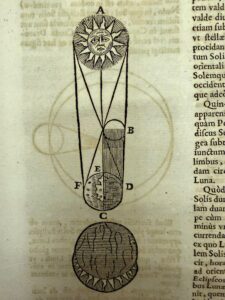
Gassendi’s Institutio Astronomica (1647) became one of the first modern astronomy textbooks at a time when it was dangerous to assert that the Sun was at the centre of the universe. Only five years earlier, the Catholic Church had refused Galileo a public burial and, as a Catholic priest, Gassendi was expected to be obedient to the teachings of the Church. Instead, he championed empiricism and demonstrated that we can understand the universe by observing it and measuring it. This superb scientific diagram of ‘De Eclipsi Solis’ is from the Cathedral Library’s copy of the complete works of Gassendi, published in Lyons in 1658.