 By Morwenna Ludlow, Canon Theologian
One of the things that I try to impress on my students is that the sea is something which both separates people and connects them. Those of us who have lived in the southwest for a while should be well aware of this of course: our two counties of Devon and Cornwall may feel far from London, but throughout their history they have been connected to the wider world by the sea. The Mayflower sailed from Plymouth. And in earlier centuries Celtic saints travelled between Ireland, Wales, our peninsula and Brittany by well-established sea-routes.
Similarly, early Christianity spread around the Mediterranean by sea. Paul was just one travelling preacher who got on a boat and spread the word. When he got to Rome he met followers of Jesus, mostly members of Greek-speaking communities who had settled in the Roman capital, having travelled west as merchants and their households. Nevertheless, sailing was neither easy nor inexpensive. It required equipment and expertise. It was unwise to sail at certain times of year. Piracy was rife, the pirates seizing ships for their cargo and enslaving passengers and crew. So – a bit like that vital train line through Dawlish – sometimes the very sea that was an essential connection was the thing that cut one off.
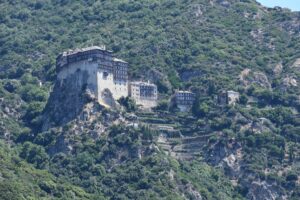
I was reminded of this forcefully on holiday when I was able to take a boat-tour around the Athos peninsular in Greece. Athos has some of the most important Orthodox monasteries in the world, but it strictly forbids entry to women. So, the only way for many people to see the monasteries is from a boat. Athos is spectacularly mountainous and to begin with it is difficult to see how anyone could live there. But then you see the monasteries – dozens of them – some clusters of buildings close to the shoreline, others perched high above, clinging improbably to the rock face.
There are reasons for this inhospitable location: the monks who first settled here were following a practice of retreat begun by ascetics like Paul and Antony of Egypt. They withdrew from the hurly-burly of city and family life to focus on God. Athos too was chosen because it was remote from major cities, but it also offered protection from attack in some very turbulent times. But monks – even hermits – were rarely completely isolated. Many people came to learn from Antony in Egypt. Even emperors came to visit Simeon in Syria, who famously lived on top of a pillar. Holy people became sites of pilgrimage. Similarly, Athos became – and still is – a major attraction to pilgrims, albeit only men. Although there are fewer monasteries these days, monks from very many different nations still live in them or visit them on retreat. And they get there by sea.
It strikes me that some people would like church to be a little like one of those monasteries high up on the cliff-face: a place for them to retreat to, protected from the turbulence of the outside world, to some extent defined by its difference from the outside world. But that is to forget that this has only ever been part of the story: although these monasteries could be cut off by the sea, the sea also connected them with other communities, just as the earliest Christian communities were connected by sea routes.
There is nothing wrong with a sense that the church is in some way set apart for God. But when the only purpose of the church is to define itself against the world, when it withdraws from contact with the world, when it sets strict rules for the admission of worldly folk – then, I think something has gone wrong. Those of us in the church need to make sure that the very things that set the church apart as special for us have not become the things that cut church off from others.