 By Harry Gray – Exeter Cathedral’s Work Experience Student
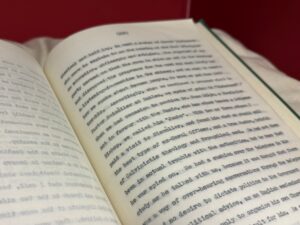
Did you know? We offer a week of work experience to students in Years 10 to 12 who are interested in pursuing a career in historic libraries and/or archives. Harry was inspired by books and archives relating to WW2 and chose the typescript of Dean Carpenter’s autobiography for a display in the West Wing Gallery.
In June 2026 I was lucky enough to spend a week on work experience in the Cathedral Library and Archives. My original perception was that I would mainly be working with older documents. However, what really caught my eye over the course of the week were the more personal stories from the 20th century.
One that I found particularly interesting was the autobiography of Dean Carpenter, who served as Dean of Exeter Cathedral between 1935 and 1950.
His recollections from 1935 to 1940 were especially fascinating. During this time, he was invited to Munich and Berlin to listen to German professors explaining the principles of Nazism.
Carpenter was warned by the organiser of the visit that the room they gathered in each evening would most likely be bugged. As a result, whenever they referred to a planned visit to Pastor Niemöller at his church in Dahlem, they would instead say they were going to Birkenhead, avoiding any mention of the pastor by name. This was because one member of the group came from the Northern English town of Birkenhead – just like my mum!
Pastor Friedrich Niemöller was a German theologian who opposed state interference in the Church. Along with two or three others, Carpenter visited him and later described finding a ‘true pastor, brimful of calvinistic theology and evangelical zeal.’ Carpenter also recalled that, although Niemöller had not yet fallen into trouble with the authorities, he knew he was being watched. He even placed cushions over his telephone because he feared it was being used to listen in on his conversations. Carpenter believed that Niemöller had ‘no desire to dictate politics to the government or even to offer political advice.’ Rather, he sought only to ‘organise his own church and parish that was made very difficult for him.’
Niemöller was arrested in July 1937 for his outspoken criticism of Nazi interference in Protestant churches. He spent the next eight years in concentration camps, including Sachsenhausen and Dachau, until his liberation in May 1945. After surviving his ordeal, he travelled the world preaching about the collective guilt of the German people for not acting sooner against Nazi atrocities.
Niemöller is perhaps best remembered for his post-war confessional poem. I believe the message of this poem is becoming more relevant in modern times. We could say that division regarding identity, beliefs and culture does not concern us as individuals. However, as Neimoller reflects, if we do not defend issues that don’t concern us directly, others may not defend us when the time comes.
First they came for the Communists
And I did not speak out
Because I was not a Communist
Then they came for the Socialists
And I did not speak out
Because I was not a Socialist
Then they came for the trade unionists
And I did not speak out
Because I was not a trade unionist
Then they came for the Jews
And I did not speak out
Because I was not a Jew
Then they came for me
And there was no one left
To speak out for me.