 By Emma Laws, Cathedral Librarian
This week we are celebrating our long-standing partnership with Exeter University Medical School. For more than ten years, fourth year medical students have had the opportunity to ‘think otherwise’ at the Cathedral Library. Our medical humanities module – What Can History Tell Us? – has challenged students to apply the arts and humanities to the science of medicine.
With over 3,000 books covering 500 years of medical history, Exeter Cathedral has one of the country’s most important collections of historic books of science and medicine. Students have discovered key moments in the history of medicine, from the introduction of systematic clinical observation by Hippocrates in the 5th century BC, to the pioneering public health initiatives of the 19th century. The course has encouraged students to consider what they can learn from the past and how they can apply their learning to their own medical practice in the future.
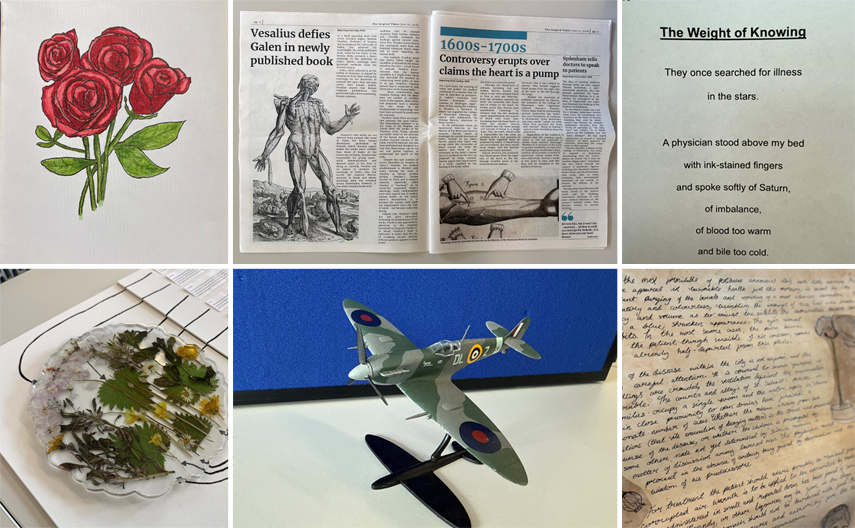
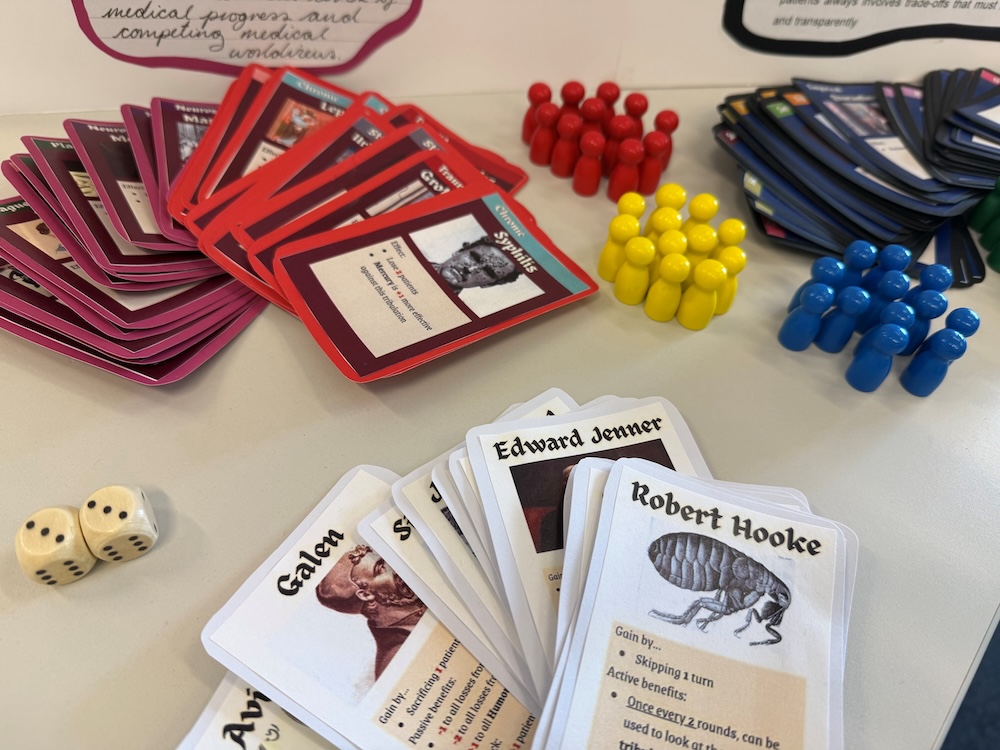
It may sound like hard work but the study of medical humanities has offered a bit of a breather for busy medical students. At the end of each year, the students have been able to take a little time out to produce a creative piece inspired by the Cathedral Library’s collections: a poem, or a play, painting, drawing, poster, podcast, sculpture, textile, interpretative dance… wherever their creativity leads them! This year’s student creative pieces include: a Persian-inspired poem, a painting of a rose at different stages of growth, a model WW2 spitfire, an entire newspaper, a selection of herbs beautifully set in resin, a replica 19th century medical report on cholera (written on tea-stained paper), and a fantastic card game that explores the trade-offs, uncertainties and consequences of medical progress.
When the Exeter physician, Thomas Glass, bequeathed his medical collection to Exeter Cathedral Library in 1786, he expressed his wish that it be available to ‘any physician being an inhabitant of the city of Exeter’. Today, we extend his welcome to anyone, anywhere. Whether you’re a medical student, or a student or teacher of the history of medicine, or just have an interest in medical history… we’d love to hear from you.