 By Ellie Jones, Cathedral Archivist
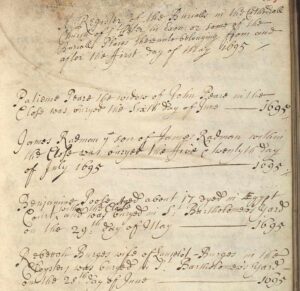
We have been spending a lot of time looking at our burial registers lately, both for family history enquiries and for workshops looking at how to read the handwriting – which sometimes borders on the illegible!
You might expect that the Cathedral’s registers would record only burials which took place in the Cathedral itself, but that is not the case. One of the registers contains records of “Burials in the Cathedral Church of St Peter in Exon or some of the burial plases thereunto belonging from and after the first day of May 1695”, and is particularly interesting for what it tells us about who was buried where, such as: “Benjamin Poole aged about 17 dyed in Aegypt Court, within the Close, and was buried in St Bartholomews Yard in May 1695”, “Catherine Browne daughter of Roger Browne of the parish of St Pauls in Exon was buried in the Cloisters on the 14 September 1695”, “Philipper Cannter the daughter of Richard Cannter living within ye Close was buried in Southernhay Yard ye 24 September 1695”, and “Benjamin Dolin a stranger who died at the New Inn in Exon was buried in ye Cathedral of St Peter ye fifth of October 1700”.
Cathedral Green was never covered with headstones and has been re-landscaped with trees and paths many times over, so it can be hard to imagine that area as a burial ground. Until 1636, however, the Green was the primary burial place in the city of Exeter. The Cathedral itself is also a place of burial, with historic interments within the body of the church and Cloisters, and a garden of rest for ashes in the Cloisters.
By the 1630s, however, the population of Exeter was too great for Cathedral Green (and the smaller city centre churches with little or no churchyards of their own) to meet the demand for burial places. Cathedral Green closed to new burials and a new cemetery was consecrated by Bishop Hall at Bartholomew Yard in August 1637. In 1664 an additional cemetery opened at Southernhay. Further cemeteries were needed in the 19th century. Bartholomew Street cemetery and the catacombs opened in 1837. A large cemetery – with grounds landscaped by Robert Veitch – opened at Higher Cemetery, Heavitree, in 1866. A further large cemetery was consecrated in Exwick by Bishop Temple in 1877. The first modern cremation in England took place at Woking in 1885, but the Exeter & Devon Crematorium did not open until 1963. Funerals and occasional interments of ashes still take place at the Cathedral today and these are still recorded in registers that will one day come to the Archives.