 By Emma Laws, Cathedral Librarian
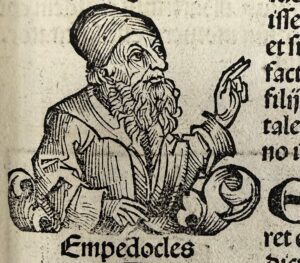
In the 5th century BC, the Greek philosopher Empedocles pioneered the theory that the universe is made up of four eternal elements, or ‘roots’: air, fire, earth and water. Later, Aristotle classified these elements according to properties relating to heat and moisture: air as hot and wet, fire as hot and dry, earth as cold and dry and water as cold and wet.
Hippocrates, a Greek physician, further developed a theory that the human body is regulated by four ‘humours’, each associated with a different element: blood (air), yellow bile (fire), black bile (earth) and phlegm (water). Furthermore, each humour is associated with a temperament: sanguine (blood), choleric (yellow bile), melancholic (black bile) and phlegmatic (phlegm). Finally, each humour has an associated season: spring (blood), summer (yellow bile), autumn (black bile) and winter (phlegm).
It all makes for a pleasingly tidy understanding of the human condition within the universe. A balance of the four humours indicates the body is healthy while an imbalance indicates disease or sickness.
The Hippocratic theory of the four humours remained the principal framework for understanding the human condition for over two thousand years. By the 17th century, new theories were emerging but Nicholas Culpeper (1616-1654), a rather eccentric herbalist and astrologer, continued to offer advice on how to counter the effects of the changing seasons on the body in his bestselling book, The English Physician (1652).
In spring, the excess of blood in the body – symbolising growth and vitality – may cause nosebleeds or fever; Culpeper advises eating light foods and exercising rather than the usual bloodletting. Nettles are an excellent remedy against the ‘phlegmatick superfluities in the Body of Man, that the Coldness and Moistness of Winter hath left behind’.
In summer, yellow bile (produced by the liver) causes the body to overheat making us irritable and aggressive; Culpeper suggests eating lettuce to cool the liver, lower body temperature and pacify anger. In autumn, black bile (produced by the spleen) slows blood circulation, causing depression, anxiety, insomnia, and joint pain; borage ‘comforts the heart, cheers the spirits, drives away sadness and melancholy… helps consumptions, madness, & such as are much weakened by sickness’.
An excess of phlegm in the brain and lungs in winter causes sluggish digestion and respiratory illnesses; Culpeper suggests rhubarb mixed with ginger can ‘purgeth choler and flegm’ while garlic (commonly added to warm foods like soups and stews) ‘avoideth tough flegm, purgeth the Head, helpeth the Lethargy… and… other cold Diseases’.
Ancient astrologers believed that planets, too, have ‘humoral’ qualities. The moon, for example, being cold and wet, is associated with winter phlegm and cold and dry Saturn with autumn black bile. Hot and dry Mars induces fevers and inflammations, as well as anger and impulsive behaviour. Culpeper was an advocate of astrological botany. He believed every terrestrial plant to be a reflection of a celestial planet and he used this model to prescribe cures. A disease of one planet can be treated by a plant ruled by the same planet, or by an opposite planet. For example, Hedge-Hyssop, a herb of Mars (a hot and dry planet) is a useful and ‘violent’ purger of cold and wet winter ‘Flegm’.
Is it all just nonsense? The Periodic Table has put paid to the theories of Empedocles and Aristotle. Modern cosmology has placed the planets at too great a distance from the earth to have any meaningful impact on the particular growth of nettles and dandelions. And, while today’s doctors may take the Hippocratic Oath, their understanding of the human body is profoundly different to that of Hippocrates. Unsurprisingly, Nicholas Culpeper’s contemporaries accused him of quackery but, before our pride gets the better of us, we ought to consider the giant shoulders that bear the weight of our modern discoveries. After all, we would likely agree with our ancient forebears that the natural world is more than just a backdrop to human existence and that our minds and bodies really do respond to seasonal changes in our environment.
Drop in at our next In Focus in the Cathedral Library on Thursday 18 June between 1pm and 3pm to discover more about how the seasons have been interpreted and imagined across the centuries.