 By Ellie Jones, Cathedral Archivist
It has been almost eerily quiet in the Library & Archives this half term without the familiar soundscape of chorister rehearsals wafting down from the song schools above. They are never far from our minds or the Archives though. Among the records we have for the Cathedral choir are several bound volumes of scores copied out by hand for their use in the 19th century.
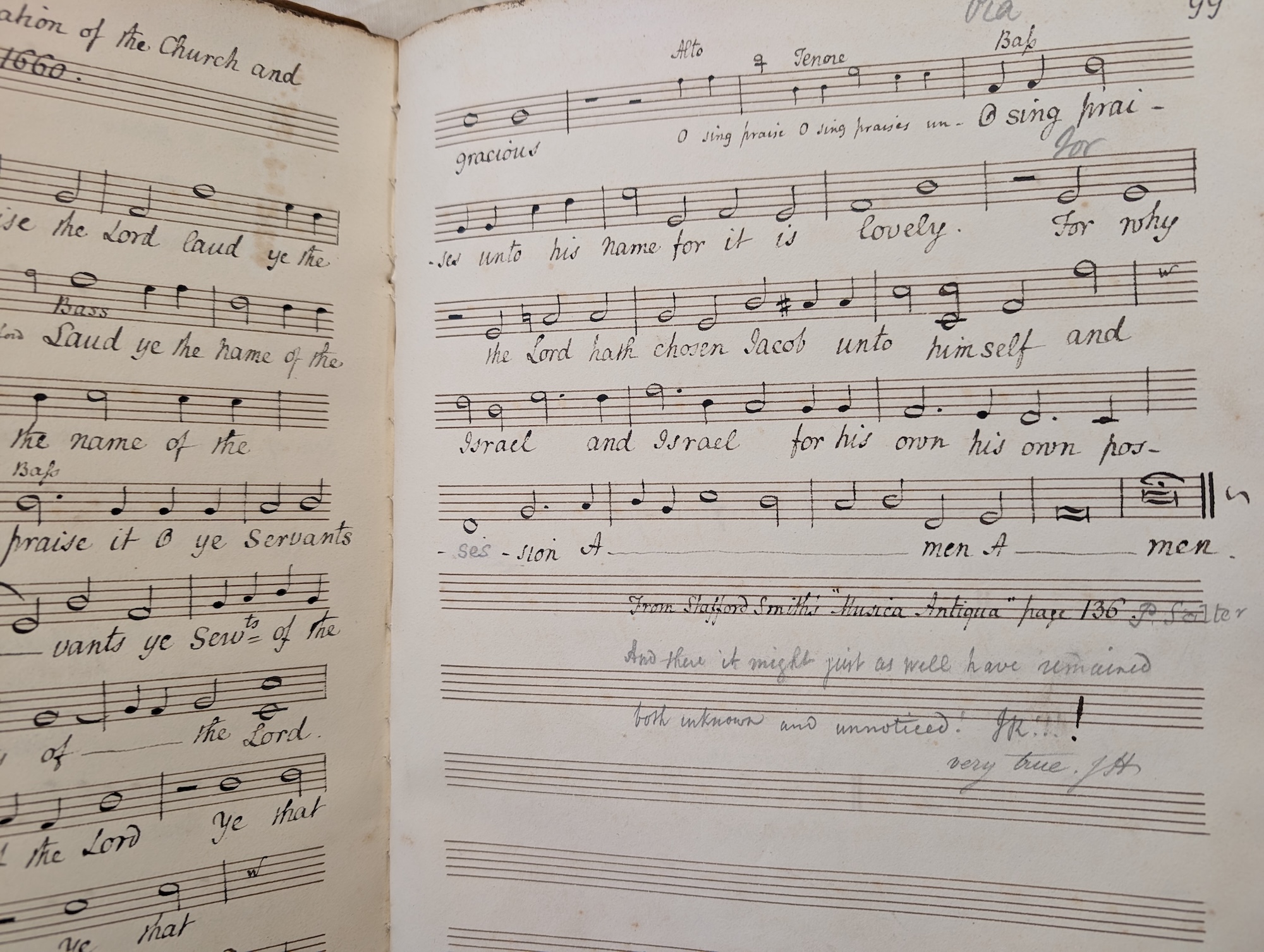
This piece, “O praise the Lord, laud ye the name of the Lord”, is a well-known verse anthem setting of Psalm 135 (verses 1–4). It was composed in 1660 by the English Baroque composer William Child in celebration of the Restoration of the Anglican Church and the monarchy under Charles II. It was copied into this book for the bass decani of the Cathedral choir from John Stafford Smith’s monumental work, ‘Musica Antiqua’. First published in 1812 ‘Musica Antiqua’ is a seminal work of early musicology, presenting and preserving some 190 historical pieces of music along with commentaries. Some of the compositions, including “O praise the Lord”, are still part of the modern choral music repertoire but, as this copy shows, that does not necessarily mean they are universally popular.
A series of pencil notes reads: “From Stafford Smith’s “Musica Antiqua” page 136”, followed by the name ‘P. Salter’. Someone then quips “And there it might just as well have remained both unknown and unnoticed! JK!!!”. JH agrees “Very true”.
Philip Salter was a secondary, lay vicar, and assistant “Informator Puerorum” (“instructor of boys”, or chorister tutor) who was commissioned to make catalogue of the choir’s music books in the 1820s. There are several possible identifications for JK and JH, so they can retain some sense of anonymity. Perhaps we should ask the present choir for their opinions when they return from their half term break…