By Emily Chircop
How did physicians in the past learn about human anatomy? For over a thousand years, they primarily studied the work of the ancient Roman physician Galen. But Galen almost exclusively dissected animals because human dissection was forbidden under Roman law. His teachings contained major inaccuracies, and physicians in the Renaissance challenged his ideas through observational study of human anatomy.
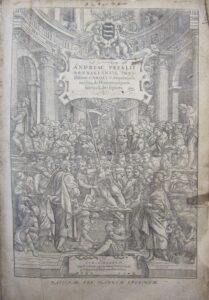 Pictured: The frontispiece of the Fabrica depicts Vesalius performing a dissection.
The world’s first permanent anatomical theatre opened at the University of Padua, Italy, in 1594. This was a purpose-built space for students to observe dissections, which were seen as the best way to learn anatomy. Padua was renowned for medical study, and scientists there were permitted to study human cadavers. Many famous physicians and anatomists travelled there to learn, including Andreas Vesalius and William Harvey. Vesalius and Harvey’s groundbreaking publications are some of the more remarkable texts in the Cathedral Library, featuring detailed illustrations of the human body.
Vesalius was a Flemish anatomist, known for his 1543 book De Humani Corporis Fabrica (On the Fabric of the Human Body). He wrote the Fabrica while teaching anatomy and surgery at the University of Padua after he graduated. It uses Galen’s teachings as a source, but also criticises them and points out mistakes.
The Cathedral Library’s copy is the second edition from 1555, which is a very impressive folio volume, containing hundreds of woodcut illustrations. The massive proportions and abundance of detail make a statement of Vesalius’ authority over Galen. Vesalius uses the images as if he is leading his reader through a dissection, and in places he shows comparisons between Galen’s physiology, drawn from animals, and his own study of humans. These comparisons are a tool to persuade readers that Vesalius is more accurate and more knowledgeable than Galen’s animal-based work. The images and text work together in the Fabrica to demonstrate Vesalius’ understanding of the body – neither can be understood alone. Although he had critics, Vesalius’ work was considered innovative, and his discoveries contributed significantly to the evolving understanding of anatomy in Europe and the shift away from Galenic theory.
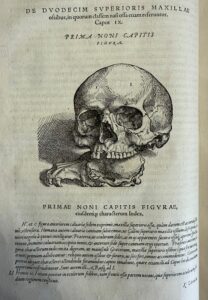 Pictured: Vesalius shows the difference between human and canine skulls.
William Harvey was an English physician, known for discovering the circulation of the blood. He began studying at Padua in 1599 – about 60 years after Vesalius graduated – and his work exists in the context of Vesalius’ legacy and the turning tide of anatomists challenging Galen in the 16th and 17th centuries. Galen believed there were two separate systems of blood in the human body, as blood in the arteries and veins looks different: nutritional blood, which is consumed by organs, and spiritus blood, which introduces air into the body. He thought blood was continually used up and replaced, rather than circulated, and that blood could pass between ventricles, through pores in the centre of the heart.
Harvey disproved all of this. He was the first to accurately describe the human circulatory system, by conducting his own dissections and vivisections to observe the workings of the heart and building on the work of other anatomists. For instance, his teacher Fabricius demonstrated the existence of valves in our veins and Harvey’s work explains why they are needed – because blood flows one way in circulation, contrary to Galen’s model.
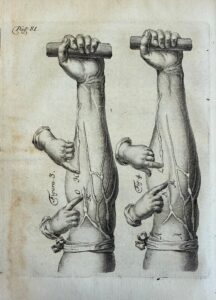 Pictured: Harvey details the blood vessels in the arms.
In contrast to Vesalius’ large, expensive book, Harvey’s De Motu Cordis (On the Motion of the Heart and Blood) was originally published cheaply, as he knew his findings would be controversial and unpopular. In fact, he worked on his theory for almost a decade before he published it in 1628, trying to garner support and show evidence of his discovery to limit criticism. The response was originally very negative – the Royal College of Physicians in England was devoted to Galen, and Harvey’s discovery proved fundamental aspects of his teachings wrong – but over time his work was accepted. By the end of his life, he was well-regarded and has since become an icon of observational science. The Cathedral Library’s copy was published in 1737, long after Harvey’s death, and the repeated printing of his book demonstrates how his ideas became popular.
Vesalius and Harvey’s work shows the process of revising Europe’s understanding of the human body that was taking place during the Renaissance. At this time, dissections were gaining popularity as the primary method of learning anatomy – observing the body for yourself rather than solely relying on the teachings of others – and both physicians emphasised observational study to challenge the existing medical theories of Galen. It is worth noting their discoveries were shaped by learning from international communities of physicians; medicine was not progressed by individuals working completely alone, but by a shifting culture of scientific observation and investigation.
–––
Further reading
Physician’s Gallery Podcast, RCPE
- Episode 34: Kristin Hussey – William Harvey and the Discovery of Circulation
- Episode 42: Vivian Nutton – An Urge to Correct: Andreas Vesalius Revised
- Episode 59: Sachiko Kusukawa – Vesalius and the Canon of the Human Body