 By Ellie Jones, Cathedral Archivist
The use of spas – with their natural, often hot, mineral-rich waters – for leisure, medicinal and therapeutic purposes have a global history dating back thousands of years. Therapeutic waters for drinking and bathing have been used in the treatment of everything from rheumatism, gout, gastritis, paralysis, wound healing and bronchitis. Spas and the associated public bathhouses became popular in the Roman Empire, where the most famous example in Britain is probably the extensive complex in Bath (Roman name, Aquae Sulis). The common name “spa”, however, derives from the town of Spa in Belgium (Aquae Spadanae).
The popularity of public bathing declined after the end of the Roman Empire, but therapeutic spas had a resurgence in some places, such as Spa, in the medieval period. Spa’s reputation for health-giving waters grew and, by the mid-16th century, it was a major destination and was even exporting its mineral waters. It was around this time that there was also a major spa revival in Britain, which grew to a high point in the 18th and 19th centuries. Towns such as Bath expanded and flourished during this period, constructing elegant new Georgian public buildings which provided luxurious places not just for bathing or “taking the waters”, but also for eating, drinking, dancing, socialising and networking. Exeter did, for a time, have its own thermal spa bath house, but it was short-lived and quite late in date. Built in a Grecian Neoclassical style in Southernhay, and fed by a small thermal stream, it opened in 1821 but closed in 1868.
Historically, the Dean & Chapter received many requests for charitable assistance to cover medical costs and between 1675 and 1767 that included several gifts towards travel to Bath for therapeutic treatments. In 1675, Mrs Floud received £5 for this purpose, as did “Greene, a poor woman”, and Thomas Dodson received 5s in 1679.
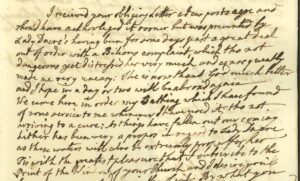
In October 1767, Thomas Barrett-Lennard, 17th Baron Dacre, wrote to Jeremiah Milles, Dean of Exeter, in response to an invitation to subscribe to a print of William Peckitt’s new Great West Window at the Cathedral. He was an enthusiastic subscriber to the project, but in his letter he also shares some health news about himself and his wife, Anna Maria, who were spending the season at Bath before moving on to London for the winter:
“I received your obliging letter a few posts ago and shou’d have acknowledged it sooner but was prevented by Lady Dacre’s having been for some days past a great deal out of order with a bilious complaint…We came here in order my Bathing which I have found of some service to me whenever I have used it… our coming hither has been very apropos in regard to Lady Dacre as these waters will also be extremely proper for her… I have no news to send you from this place where I have been only ten days & the greatest part of them Lady Dacre sick; and where there are hardly six people of my acquaintance…”
The Cathedral Library also has several books, written between the 17th and 19th centuries, which discuss the virtues of the medicinal use of spas and baths. We even have a copy of the Bishop of Bath and Wells, the Right Reverend Thomas Ken’s, late-17th century ‘Prayers for the use of all persons who come to the baths for cure : to which are added, three hymns, for morning, noon, and midnight’, which offered spiritual guidance for those visiting the medicinal baths of Bath.