 By Ellie Jones, Cathedral Archivist
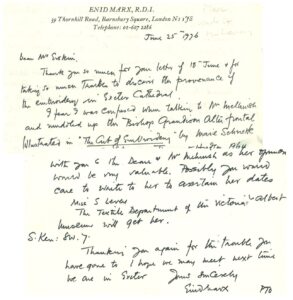
This week we came across a letter from Enid Marx, a 20th century designer, illustrator, printer, engraver, and art teacher noted for her vibrant geometric and folk art-inspired prints. Many of you will recognise her work, but you may not know her name or her connections to Exeter.
In late June 1976, Marx wrote to Mrs Erskine (the Cathedral’s Archivist) about a visit she had recently made to examine the Cathedral’s historic textiles. The visit was part of her research for the Royal Mail’s Christmas 1976 postage stamps, which were to be on the theme of English medieval embroidery. This was Marx’s second foray into stamp design, having previously created the low-denomination stamps for the coronation of Elizabeth II in 1953. Marx writes about a muddled conversation she had had with Mr Melhuish (one of the Virgers), and about some sketches and photographs she had shared with her friend, Santina M. Levey. The Cathedral’s textiles were not going to be suitable for the stamps but, at Marx’s suggestion, Miss Levey (keeper of textiles at the Victoria & Albert Museum) visited the Cathedral that summer to make a closer inspection of the textiles (there will be more about that in a future edition of Cathedral Life). In a postscript, Marx asks Mrs Erskine to “Forgive a rather incoherent letter, I am in bed with an attack of summer flu”.
Many people will be familiar with Marx’s work, perhaps without realising it. You may have seen her prints, curtain fabrics or upholstery designs furnishing mid-century homes, you may have her cover designs on books published by Penguin or Chatto & Windus on your bookshelves, or you may even remember some of the children’s books she wrote and illustrated.
Even if you don’t have her designs at home, you may well have sat on London Underground trains upholstered in her striking geometric moquette (a type of hard-wearing carpet-like fabric). In the 1920s Marx was a contemporary of artists like Henry Moore and Eric Ravilious at the Royal College of Art, and came under the tutelage of Paul Nash who described that era as an ‘outbreak of talent’. During the 1930s Marx’s repeating abstract patterns received widespread popularity and acclaim and, in 1937, she was one of a small number of designers who designed fabric for the London Underground seats which remained in use for decades.
Marx wrote to Mrs Erskine from her home and studio at 39 Thornhill Road, N1, London where she had lived with her partner, the historian Margaret Lambert, since 1965. They shared the property with their friend Eleanor Bruening, a historian, and Lambert’s sister Grace also spent time there (when she wasn’t in Exeter). Marx would have known Exeter quite well through the Lamberts, having lived here for a time while Margaret was teaching at the university from 1949-1951, and through visits to Grace, who lived here for many years.