 By Ellie Jones, Cathedral Archivist
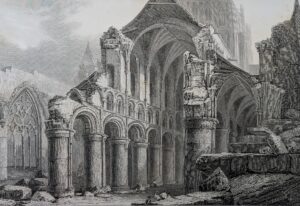
In December 1786, the Dean & Chapter at Exeter authorised a gift of £50 (roughly equivalent to about £4000) to the Dean & Chapter at Hereford Cathedral. This was a response to the dramatic collapse of Hereford Cathedral’s west tower on 17 April 1786 – Easter Monday.
Whereas Exeter Cathedral still has its two original towers – arranged in a unique configuration to the north and south of the nave crossing – Hereford now has just one. Prior to the calamitous collapse at Easter 1786, Hereford had two towers, a central tower and a western tower, which had been added in the 15th century. Structural problems resulted in the eventual collapse of the western tower, which also destroyed the west front and part of the nave.
In his ‘Cathedral Antiquities’, published 50 years later in 1836, John Britton explains how his own engraving was based on a drawing made by his friend Mr Hearne, who was at Hereford in 1786. Britton is not altogether kind in his comments about the restoration work which had been undertaken by James Wyatt, remarking that he had “rebuilt in a very different, and I must add a very indifferent, style”. Whether or not Wyatt’s work is admired as much as that of his predecessors, it is still a testament to the resilience and ingenuity of generations of architects, masons, builders and surveyors that the ancient cathedrals of Britain can grow, adapt and survive, even in the face of disasters on a scale as large as that which hit Hereford 240 years ago.