 By Morwenna Ludlow, Canon Theologian
‘God, grant me the serenity to accept the things I cannot change, the courage to change the things I can, and the wisdom to know the difference.’
This prayer captures an ageless spiritual wisdom. And it’s not bad advice for secular roles, too, especially those in large institutions. My former line-manager and I used to frequently ask ourselves, ‘Where do we have agency in this?’
In a world currently dominated by unpredictable international events with potentially widespread consequences, we can often feel that we have absolutely no agency at all. Whether it reaches us from the radio, TV or social media, the latest news can be an insistent draw on our attention. For those who have family in the Middle East, this is very understandable. But what do we do about those events in the international news? Many of us will pray, of course; but what can we do, practically?
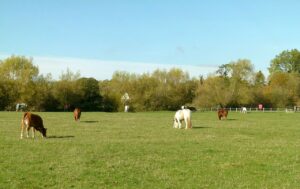
This question was raised by Professor Luke Bretherton, who gave the Prideaux lecture in Exeter last week. He was in no way dismissing our responsibility to be aware of wider political and social movements, but he did point out the way in which international news can flood our airwaves, screens and brain-space, so that we are less aware of the places where we actually live. And it is here, he argued, that we have real agency. In particular, Luke set out for us a vision of collective local activity based on the principles of commons: material or social goods, shared by a human community, organised through a set of informal or more formal rules and practices. Just as some communities grazed animals on a parcel of common land (and some still do) so there might be other areas of life which we could organise in a similar way. By acting together, locally, we can empower each other to make a real difference. To be clear, this does not (necessarily) entail reclaiming local parks for grazing sheep or cows. The principles of the ‘commons’ could apply to all kinds of collective activity, beginning with very modest working with physical neighbours in a street to support each other in, for example, a power cut. The idea could extend to the digital world too, by making certain information truly free to share – just like the images in Wikimedia commons, from which I chose the photo to go with this piece. The idea of the ‘commons’ has as its focus a shared local or particular good – not an aspiration for sharing all things in common – and gives us a practical goal. It requires a lot of hard work in communicating with and listening to each other in ways which respect each other’s dignity and agency.
There is much to reflect on here and the point is that each of us will need to reflect on our own particular context. But it was a heartening and practical call to have the wisdom to know the difference between what we can and cannot change – and to have the courage to act.