 By Emma Laws, Exeter Cathedral Librarian
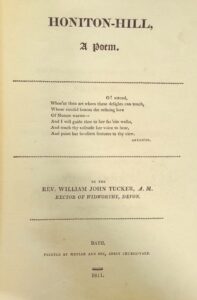
A couple of weeks ago I came across a very rare 1811 printing of a poem entitled ‘Honiton-Hill’ by the Reverend William John Tucker (1743-1830). (The only other copies that turned up in a quick internet search were at the Devon Heritage Centre and at the Cecil H. Green Library at Stanford University.)
Tucker was born in Kilmington near Axminster in East Devon and educated at Queen’s College Oxford. He was Rector of Widworthy, a village east of Honiton, from 1769 or 1770 until his death. He doesn’t seem to have been a prolific writer; in fact, apart from this poem, he seems to have published only one other piece – a topographical account of the parish of Widworthy in The Gentleman’s Magazine in 1791. He describes the use of land, the number and type of cottages, the occupations of the residents and the buildings, including the church and various manor houses. He also gives a little of the history of the parish and a brief ‘who’s who’ of its notable residents. It may not be an inspiring read but it’s evidence that Tucker was proud of his parish. He also seems to have been enviably content with his lot in life, describing his own parsonage as ‘about half a furlong distant from the church … an old building covered with thatch, but [with] some good rooms, and … not inconvenient.’
‘Honiton-Hill’, however, is rather different. It describes a view from the Blackdown Hills Area of Outstanding Natural Beauty across the Otter Valley towards Exeter. It’s a view that Daniel Defoe (1660-1731) recalled in his 1724 account of A Tour Thro’ the Whole Island of Great Britain as ‘the best and pleasantest part of the whole county’. In fact, Defoe recommended it ‘to any gentlemen that travel this road … if they please to observe the prospect for half a mile, till their coming down the hill, and to the entrance into Honiton, the view of the country is the most beautiful landskip [sic] in the world, a meer picture; and I do not remember the like in any one place in England.’
Tucker’s poem belongs to the popular genre of topographical poetry, which describes specific landscapes and vistas. The genre emerged with John Denham’s 1642 poem, ‘Cooper’s Hill’, which pictured in words the Thames Valley near his home in Egham, Surrey. Aesthetic ideals of the Picturesque and Sublime were developed a century later by the priest and travel writer, William Gilpin (1724-1804), in his 1782 travelogue, Observations on the River Wye. Gilpin defined the Picturesque as the ‘kind of beauty which is agreeable in a picture’ and proposed a set of rules for depicting – and improving – nature. Landscapes, he thought, should include contrast and variety, light and shadow, framing, foreground and distance, and rugged and rustic features – perhaps even a ruin or two.
This definition of the Picturesque underpins Tucker’s poetic rendering of the view from ‘Honiton-Hill’. He describes the ‘varied beauties’ of the Otter Valley, ruins of buildings destroyed by fire, and the River Otter ‘that rolls its way through meads and pastures’ into the distance. He frames the view in the foreground with stately oaks and tall yews with ancient spreading branches. Hembury Fort ‘lifts up its head sublime, grand, and majestic’ while Dumpdon Hill Fort ‘rears its venerable head; the distant ocean, and surrounding lands, its lofty insulated peak commands’. Combe-Raleigh has ‘a place important in the view’ with its ‘well dress’d woods’ and ‘fertile hills’. Dartmoor, ‘render’d by distance blue’ lies at the end of ‘this pleasing variegated view’.
‘Honiton-Hill’ is, perhaps, best defined as a prospect poem – a genre of topographical poetry that describes a panoramic view from a high vantage point, blending the description of the landscape with philosophical reflection. Tucker leads us from observation of spatial distance to contemplation of temporal distance. The rising sun viewed within a landscape is but a ‘transient joy’; ultimately, ‘a far more glorious sun shall bless these eyes, the Sun of Righteousness in heavenly skies’.