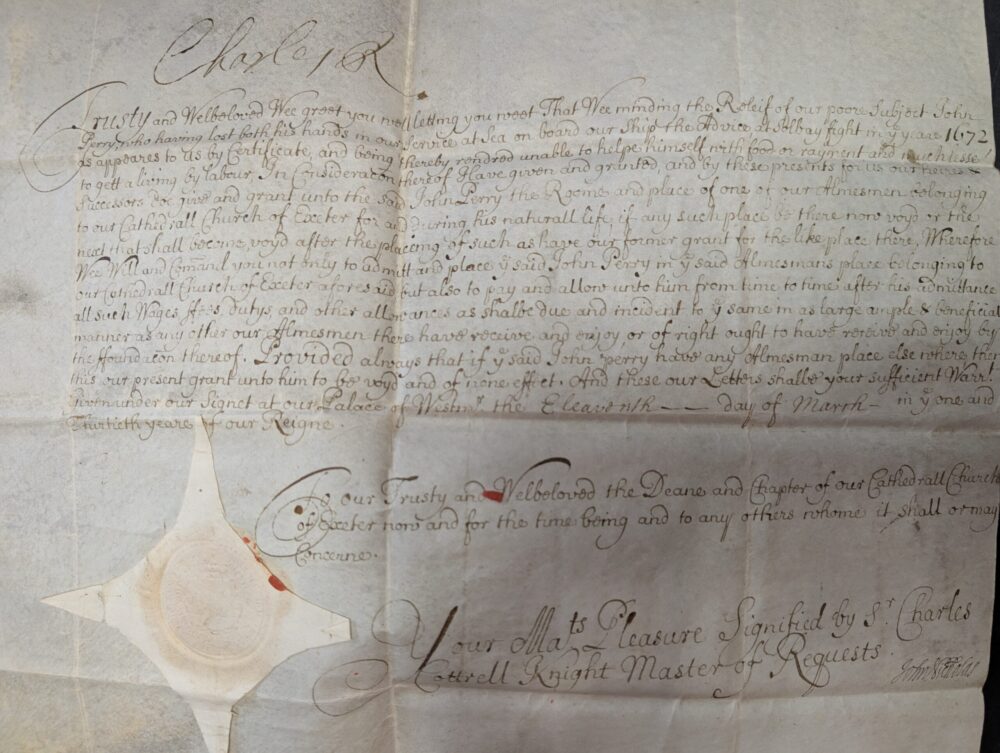
 By Ellie Jones, Cathedral Archivist
This letter, signed by Charles II, is a royal letter instructing the Dean & Chapter to give the next available place in St Catherine’s almshouses in Exeter to John Perry, a veteran of the Third Anglo-Dutch War. Perry “having lost both his hands in our Service at Sea on board our Ship the Advice at Solbay fight in 1672 as appears to us by Certificate and being thereby rendred unable to helpe himself with food or rayment and much lesse to get a living by labour”.
The Battle of Solbay (Sole Bay, off the coast of Southwold, Suffolk) was the opening action of the Third Anglo-Dutch War, with 98 ships on the Anglo-French side and 75 on the Dutch side. The battle began early in the morning of 28 May 1672 (7 June by the Dutch calendar). The long 14-hour sea battle ended in a draw, with nearly 2000 deaths on each side, and more than 800 serious injuries. Despite a lack of established military and naval hospitals at the time, initial frontline care for the injured sailors was provided in East Anglia. When veterans were resettled back home, there was often a lack of good ongoing medical and financial assistance. The Crown would sometimes issue letters such as this one to hospitals and almshouses to guarantee a place for life for these veterans. We have two other similar letters, one issued to Matthew Swaffield, who lost his toes and part of his foot at Solbay on board the HMS Warspite and one, slightly later, to Richard Mills who was ruptured in the groin in service aboard the Royal Sovereign in 1692.
HMS Advice was a frigate of the Royal Navy originally built in 1650 but rebuilt in 1698. This later Advice gained some fame for transporting the infamous pirate Captain William Kidd back from Boston to England to stand trial for his crimes in 1700. Kidd was executed in 1701, and the Advice was eventually lost to French privateers in 1711.