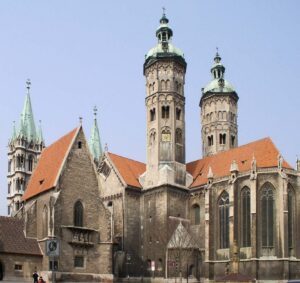
 In October, Cressida Parsons of our Events team and I went to Naumburg in German to assist with the planning of the 2028 Northern European Cathedrals Conference. Building upon the 2026 conference here in Exeter, “Cathedrals – seats of Wisdom”, the 2028 conference will explore cathedrals as places of hope, and their ability both to be a focus for local artistic and cultural tradition, also to be places of stability and witness in changing circumstances.
Naumburg Cathedral in Saxony will be celebrating its millennium un 2028. A remarkable building, it is a testimony to the power of the church as artistic patron, with unparalleled stonework, and exquisite figurative carving. It influence reaches across Europe – one can see its influence upon the figures of our West Front, for example. It was also a profound influence upon Sir George Gilbert Scott, who renovated this and many other English Cathedrals in the nineteenth century. The glazing, too, is world-class.
Unusually, the cathedral has two quires, an east quire and a west quire – rather than enlarge the quire to accommodate more canons, as Exeter did from 1280 onwards, at Naumburg, they simply built another quire, with second pulpit screen, at the west end. In addition they had two cloisters and a church for the town people alongside the cathedral (still in use during the winter months, as the cathedral is unheated!).
The Reformation was initially kind to Naumburg, and Martin Luther gave them his one and only bishop: a short-lived experiment. But the college of canons remained at Naumburg unaffected by history and ecclesiastical trends until the Treaty of Vienna in 1815, and Saxony was taken over by the Prussians. The Prussians identified Naumburg as a picturesque town for retired army officers, and so it was preserved as a genteel retirement town – the Budleigh Salterton of Saxony. Because of the greater strategic and industrial importance of nearby Leipsig and Halle, Naumburg escaped bombing in the Second World War and, under subsequent East German and Soviet rule was retained as a town for Russian officers. While not well maintained during the Democratic Republic, it was not harmed by a “modernizing” council.
Post-reunification, the Cathedral has taken a lead on education in the city, running two very successful schools in its precincts: “Noah’s Ark” kindergarten, and Cathedral Junior School. These have brought new life to the cathedral quarter, and new hope to the city. Naumburg has become a major tourist destination and has develped extensive education work with local schools, around the themes of stonemasonry and glazing.
The future now is unsettled. Recent elections have the the AFD take the greatest proportion of the vote, and its hard-line, far-right agenda is a concern to many, as is the increasing pro-Russian sentiment to the East of Saxony. The region is being depopulated, with few new jobs for young people and little opportunity. Climate Change is having a significant impact upon the region, with only the wine industry booming in the now regularly searing summers.
Against all of this change, the Cathedal has stood as a monunment to faith in God and the people of the city. As with all cathedrals, including Exeter, its survival was not guaranteed. It survived Reformation, religious wars, Napoleonic legacy, Nazism, total war, soviet occupation and reunification: God’s providence must have been in there somewhere. Also, the sheer beauty of the building speaks volumes of the need not only for God by for art, for the skills to produce sculpture from stone, and the transforming effect of all of the above upon many different political and religious regimes. None of them had the courage to eradicate such beauty, the humanity it depicts, and the building itself, quite apart from its ministry, has been a profound sign of hope for its people and wider community.
We take our cathedrals for granted I think – as if they will always be here. But that is not a given. Just think of the 800 English monasteries, two within the walls of Exeter, that were demolished at the reformation: they are not much missed. Cathedrals are surely places of hope, but in order to be so, they have to be nimble and adaptable. Above all, they need to be confident their very stones are worthy of preservation. For those stones are not only the story of those depicted, but the faith of those who crafted them, speaking profoundly of our shared human condition, and the story of the city itself.