 By Emma Laws, Cathedral Librarian
Last month, I wrote about Tyndale 500. Well, this week, it’s Good News 50. The Good News Bible was first published in its entirety in 1976. However, the story started a decade earlier. In the 1960s, the American Bible Society embarked on a project to publish a version of the Bible that would ‘present the Biblical content and message in a standard, everyday, natural English’. In September 1966, the Society published the New Testament; the Old Testament followed in 1976 and then the two Testaments appeared together as the Good News Bible, or Today’s English Version.
When I was at school, the relatively new Good News Bible was used in Religious Education lessons. It’s easy to see why. It contains novel features that make it easy to navigate. Each book of the Bible has an introduction that summarises the events and main themes. Cross-references to parallel accounts and related passages appear at the bottom of each page. Section headings throughout each chapter make it easier to get a sense of the narrative and to locate particular passages – for example, John 2:1, is headed ‘The Wedding in Cana’ and Luke 8:22 has the title ‘Jesus Calms a Storm’, with the addition of cross-references to Matthew 8:23-27 and Mark 4:35-41. There are maps designed to ‘help the reader to visualize the geographical setting of countries and localities mentioned in the Bible’, indexes, and even a chronology of biblical events.
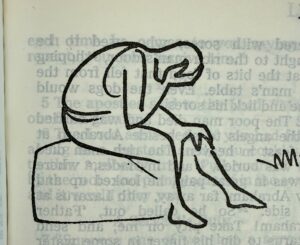
What I recall most, however, are the striking illustrations. They were ground-breaking. The Good News Bible contains over 600 simple but lively line drawings by the Swiss artist, Annie Vallotton (1915-2013). Vallotton mastered an economy of line to convey movement, emotion and, importantly, meaning in just a few lines of her pen.
Posture and gesture, rather than detail, communicates the narrative: the prodigal son with his head in his hands in Luke 15; Jesus reaching out to Simon’s mother-in-law in Mark I; Peter with his head in his hands after the cock crows a second time in Mark 15; and the incredibly moving vignette of Mary sat quietly pondering the words of the shepherds in Luke 2.
Vallotton’s little vignettes, sometimes several on a page, not only bring biblical events and people to life but also serve as visual interpretations of the text. In fact, her powerful illustration of two people carrying boulders to the foot of the cross in Romans 6 has inspired Christian imagery ever since. It also demonstrates her own deep understanding of the events she was illustrating.
Apparently, Vallotton left the faces of her people blank, even that of Jesus, because she wanted readers across cultural and national borders to imagine the people in the Bible for themselves. And, since her illustrations look rather like the outlines in colouring books, they were, evidently, eagerly coloured in by children! The Good News Bible paved the way for modern alternatives, each seeking to speak to contemporary readers: the New Living Translation, the New International Version, The Message, and others. But, fifty years on, the Good News Bible, with Vallotton’s ingenious illustrations, is still in print.