 By Emma Laws, Cathedral Librarian
In 1526, the German printer, Peter Schöffer the Younger, printed William Tyndale’s English translation of the New Testament. Around 150 years earlier, John Wycliffe had begun the process of translating the bible from the Latin Vulgate into English – a translation of a translation. However, William Tyndale (c.1494-1536) was the first to translate the New Testament and parts of the Old Testament into English from the original Greek and Hebrew.
Prior to the advent of printing in the West in the mid-15th century, manuscripts of Wycliffe’s bible were painstakingly copied by scribes; about 250 survive today. Tyndale’s New Testament was printed in an edition of thousands; even so, only three copies of the 1526 edition are known to exist today.
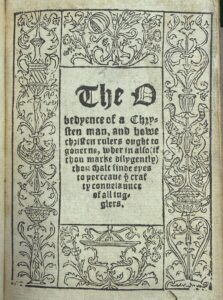
While we cannot boast a precious Tyndale New Testament at Exeter Cathedral, we do have an early edition of Tyndale’s groundbreaking treatise, The obedyence of a Chrysten man. First printed in Antwerp in 1528 (the Cathedral Library has the 1561 edition, printed in London by Wyllyam Coplande), Tyndale’s treatise paved the way for the English Reformation. Tyndale argued that monarchs hold authority from God, not the Pope, handing Henry VIII the perfect weapon to sever ties with Rome and establish himself as head of the Church in England.
A significant part of Tyndale’s treatise deals with his views on the authority of the Bible. He argued for Martin Luther’s concept of Sola Scriptura – the Bible as the sole and infallible authority for Christian faith, doctrine and practice. He accused the Pope of withholding the Bible from ordinary people: “for the pope hath taken it clean away, and hath made it his possession. He hath partly locked it up with the false and counterfeited keys of his traditions, ceremonies and reigned lies; and partly driveth men from it with violence of sword: for no man dare abide by the literal sense of the text, but under a protestation, ‘If it shall please the pope’.”
Tyndale wanted ordinary people to read and understand the Bible in their own languages and his English translation eventually became the foundation for both the 1560 Geneva Bible and the 1611 King James Bible. However, Tyndale’s democratisation of the Bible was not popular. In 1536, he was found guilty of heresy and burned at the stake.
Arguably, Tyndale’s advocacy for individual access to the Bible contributed to the fracturing of the Western Church. Individualism trumped centuries of Christian tradition and scholarship and gave rise to numerous sects and denominations. Towards the end of the 16th century, Richard Hooker, whose statue overlooks St Martin’s Church in the Cathedral Close, sought a middle path in his famous work, Of the Lawes of Ecclesiastical Politie. Hooker argued, “men are blinded with ignorance and error” and their “affections doe frame their opinions”. Therefore, he concluded, personal intuition should be accountable to human tradition and reason: ‘utterly to infringe the force and strength of man’s testimony were to shake the very fortress of God’s truth… although the Scripture be therein the ground of our belief; yet the authority of man is, if we mark it, the key which openeth the door of entrance into the knowledge of the Scripture. The Scripture could not teach us the things that are of God, unless we did credit men who have taught us that the words of Scripture do signify those things.”
William Tyndale is remembered on 6 October in most Anglican and Lutheran traditions.