 By The Very Revd Stephen Waine, Interim Dean
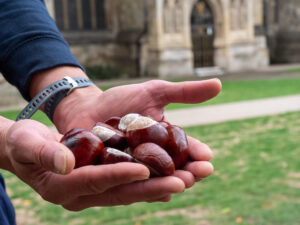
The horse chestnut tree on the Cathedral Green is a great attraction at this time of year as it yields its harvest of glorious conkers. Underneath its branches gather children gathering up what they need to play the game, hoping that their conker will be the one to smash all others while keeping a careful count of just how many rivals it has defeated. Grown-ups too have been seem carefully choosing which to pick up. Photographers have been seen kneeling down before the tree, hoping for the perfect angle to create an artistic image of the reddish-brown nut, perhaps still in its spiney case, with the backdrop of the Cathedral to frame their image. Others may have gathered them to take home: apparently placed among the winter’s woolly jumpers they are a good deterrent to moths which might otherwise enjoy making holes in them.
On Michaelmas Day I was able to join the congregation in Truro Cathedral as Bishop Graham James celebrated the 50th anniversary of his Ordination as priest. Before he retired Bishop Graham was Bishop of Norwich, and during his sermon he made reference to the 14th century mystic known as Julian of Norwich. Julian was suffering from what was thought to be a terminal illness when in 1373 at the age of 30 she had a series of sixteen visions which revealed to her something of the love of God. Eventually after a many years of contemplation Julian wrote down her conclusions in what was the first book to be written by a woman in English, ‘Revelations of Divine Love.’
One of her visions involved not a horse chestnut but something small and round, the size of a hazelnut which she saw in the palm of her hand. She wrote: ‘”What is this?” And the answer came, ‘It is all that is made.’ I marvelled that it continued to exist and did not suddenly disintegrate; it was so small. And again my mind supplied the answer, ‘It exists, both now and for ever, because God loves it.’ In short, everything owes its existence to the love of God.’” Julian continues, “We have got to realise the littleness of creation and to see it for the nothing that it is before we can love and possess God who is uncreated. This is the reason why we have no ease of heart or soul, for we are seeking our rest in trivial things, which cannot satisfy, and not seeking to know God, almighty, all-wise, all-good. He is true rest. And it is his will that we should know him, and his pleasure that we should rest in him.”
The Cathedral is a place where we can know God and rest in him, and respond to the invitation of Jesus who said, “Come to me, all who labour and are heavy laden, and I will give you rest.”