 By Ellie Jones, Exeter Cathedral Archivist
The iconic West Front of Exeter Cathedral, with its magnificent carved stone image screen, is a medieval masterpiece familiar to many of us — but how well do you really know it? Who and what do those carvings actually depict? That is what we will be considering at this month’s ‘In Focus’ exhibition on Tuesday 22 September. The exhibition will feature historical books and documents which throw the spotlight on some of the figures immortalised in stone, including King Cnut, Edward the Confessor, and St Bartholomew.
Begun in the early 1340s and taking more than a century to complete, the ornate limestone screen rises across three tiers topped with crenellated battlements. While larger figures of kings and saints set within intricate canopies dominate the structure, they rest upon a row of supporting angels at the bottom. Meanwhile, multiple hidden faces peer over the battlements at the top. At ground level, passers-by can easily spot dozens of smaller carvings, from curious human faces to mythical beasts, animals, and delicate foliage.
Perhaps it is not entirely fair to ask exactly who these figures are when we are still not absolutely certain ourselves. While excellent financial records for the cathedral’s construction survive, no contemporary drawings or blueprints of the original artistic vision remain. Furthermore, the figures—once brightly painted—have been badly eroded, and some were repaired or replaced centuries later. Today, scholars must act as detectives, using clues like iconography, emblems, and the positions of the figures to decode their identities and read the stories immortalised in stone.
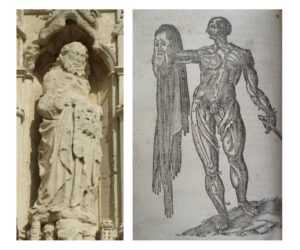
Some figures are easier than others to identify. Next time you visit, stand back and look at the figure in the corner on the top row, to the left of the Great West Door. This figure holds something draped over his left arm. Look closer, and you will see that this drapery has eye holes. This is St Bartholomew, who was martyred by being flayed alive and is traditionally depicted holding his own skin. It is a striking representation frequently found in Christian art, which even made its way into printed medical texts such as Helkiah Crooke’s ‘Body of Man’ (1634), which is one of the items that will be on show on 22 September.
Join us between 1-3pm on Tuesday 22 September if you would like to get to know some of the other figures on the West Front image screen.
Photo: St Bartholomew on the West Front image screen and an anatomised figure reminiscent of St Bartholomew in Helkiah Crooke ‘Body of Man’ (1634)