 By Emma Laws, Exeter Cathedral Librarian
I haven’t seen Christopher Nolan’s IMAX Odyssey experience yet. I need to prepare for a three-hour movie in a cinema – like making sure I have enough snacks for a long car journey. However, it’s estimated that on average it would take about 11 hours to read The Odyssey from cover to cover so if Christopher Nolan can condense the whole story into three hours he’s doing well. (The Iliad is even longer…)
If you want the extended director’s cut of Homer’s epic poem, you need to go back to the 12th century. Archbishop Eusthathius of Thessalonica did the opposite of Christopher Nolan; he extended and expanded the texts of both The Odyssey and The Iliad in a massive multi-volume commentary, explaining in great depth features of Homer’s vocabulary and grammar and unpacking cultural, historical, geographical and mythological references. Eustathius’s monumental commentary on the works of Homer was eventually printed in two volumes by Hieronymus Froben in Basel between 1559 and 1560.
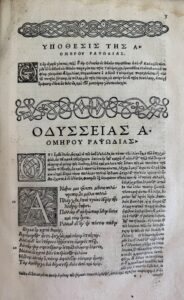
This image from the Cathedral Library depicts the opening of the first book of The Odyssey in Eustathius’s commentary. Homer’s original Greek text is printed on the left of the page in slightly larger font, beginning with a decorative woodcut capital A for ‘Andra’, meaning ‘Man’. Eustathius’s commentary, in a smaller font, surrounds Homer’s text, and begins (just above the woodcut capital A) with a decorative capital O for ‘Oti’ – we might say, ‘Note that…’.
This was a prestige publication – an expensive large folio edition with a complex page layout and beautiful ornamental typography. The lovely decorative headpiece is typical of Renaissance printing from Basel. If you look carefully you can spot the date 1545 printed within the design – not the date of the book, but an indication that the woodcut was made for an earlier book and, here, reused. Certainly a busy page, it must have presented quite a challenge for the 16th century compositor whose job it was to set the movable type and woodcuts for printing.
You might be forgiven for thinking that at least one of the woodcut capital letter Os signifies the word Odysseus. In fact, Homer doesn’t mention Odysseus by name in the first line of his poem; instead the poem begins with the word ‘andra’: a ‘man of many ways’ and of his struggle to return home.