By Ellie Jones, Exeter Cathedral Archivist
Weathervanes or weathcocks are architectural features which indicate the direction of the wind. Cockerels are a popular motif, but they can take the form of everything from a simple triangle to dragons and cars. The word “vane” comes from an Old English term for a flag.
There is archaeological and other evidence for the use of weathervanes across the world dating back millennia. There is even a depiction of a man installing a weathercock on Westminster Abbey embroidered on the Bayeux Tapestry.
Weathervanes are a common sight on church towers and steeples. There is a story that Pope Gregory I saw the cockerel as a proper emblem of Christianity and had a weathercock installed on his basilica in the Vatican in the in the late 6th century. Two hundred and fifty years later Pope Nicholas I ordered weathercocks to be placed on every church steeple.
A popular Exeter anecdote relates how the teenage princess Catherine of Aragon (future wife of Henry VIII and queen of England), who spent two nights at the Deanery in 1501, was kept awake by the noise from the weathervane on St Mary Major church. Someone was ordered to climb up and take it down so she could sleep (then promptly put it back when she left).
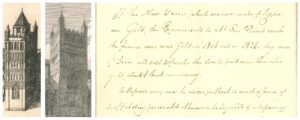
The steeple on the Cathedral’s north tower was pulled down in the mid-18th century, and its “old weather cock [was] to be given to the parish of St Sidwell’s to be re-erected there”. The eight weathervanes, placed on the corner pinnacles of the two towers, remained. Records show that the weathervanes were inspected and balanced regularly to keep them safe and moving in the wind, just as they are today. Exposed to the elements, they also had to be replaced or re-gilt at intervals, usually by the Cathedral’s blacksmith.
In this letter, dated 21 October 1837, the Cathedral surveyor Robert Cornish discusses the costs of replacing the weathervanes on the north tower. Extensive repairs were needed to the north tower following bad storms: ‘If the New Vanes (which are now made of Copper) are gilt, the Expense will be about One Pound each. The former ones were Gilt in 1816 and in 1826, they were of Iron and cost 30s each – the scroll part were then also gilt, which I think unnecessary”.
Now mostly considered decorative, they do have a function, and at least one colleague at the Cathedral looks up everyday before setting off on the cycle ride home to see if the wind will be for or against them on the journey.
Bonus: Eagle-eyed visitors to the Cathedral admiring the window depicting St George and the Dragon in the chapel of St James may even spot the signature of the 20th century stained glass artist, Hugh Easton, who uses a weathercock and his initials to sign his work.
—
Pictured: Weathervanes on the north tower shown in 1660, c.1803 and discussed in 1837.