By Emily Chircop
Until the 16th century, almost all Western medicine relied on key concepts from ancient Greece and Rome, such as the teachings of Hippocrates and Galen. Less often recognised are the physicians and philosophers from the Islamic world who publicised and expanded on these classical texts. Islamic scholars were central to the development of European and worldwide medical knowledge.
One particularly significant author is Ibn Sina (renamed Avicenna in Europe), a physician and philosopher who lived from circa 980 to 1037 in Central Asia and Persia, mainly in what is now Uzbekistan and Iran. He lived and worked in the middle of the Islamic Golden Age, a period where science and culture flourished in the Islamic world.
Ibn Sina’s most famous work is The Canon of Medicine, an encyclopedia that encompasses the medical knowledge of the classical and Arabic worlds, including the foundational studies of Galen. His text was highly regarded for its clear organisation and comprehensiveness, which made it a more useful reference text than the works of Galen.
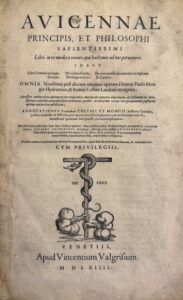
Pictured: The title page of the Canon displays the symbol of its Venetian printer.
The Canon was highly influential to medieval European medical study. In the 12th century, new translations of the text from Arabic into Latin were completed, which formed the basis of medical learning in Latin for hundreds of years – Ibn Sina’s Canon was used in university teaching in Italy and across Europe well into the 17th century. The volume of the Canon in the Cathedral Library was produced for this purpose. It was printed in 1564 in Venice and edited by Giovanni Costeo and Giovanni Mongio. Many key centers for medical study were located in Northern Italy at this time, including the University of Bologna, where Costeo taught, and Padua and Venice, where Mongio practiced medicine.
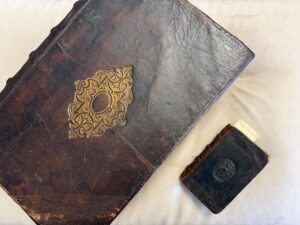 Pictured: The size difference between Ibn Sina’s Canon (left) and Selections from Galen (right).
A very large and impressive volume, the Canon comprises over 1500 pages. It makes a striking comparison to a contemporary publication of Galen’s selected works from 1560, which is remarkably tiny. Galen’s book was likely designed to be carried around, while the Canon was a prestigious edition for students and doctors to consult when they needed more detailed information.
Ibn Sina’s Canon is a landmark publication in the history of medicine. It was foundational to the European medical tradition and, during the Renaissance, alumni of the Italian universities who may have studied the Cathedral’s edition of the Canon built on the theories they learned to make revolutionary discoveries. The longevity and widespread use of this text shows its importance and its central role in transmitting knowledge from the Greek, Roman, and Arabic worlds across centuries and continents.
–––
Further reading
Ibn Sina: The Persian Polymath, BBC Sounds The Forum series