 By Emma Laws, Exeter Cathedral Librarian
This month marks 150 years since the death of Samuel Sebastian Wesley (1810-1876), organist at Exeter Cathedral from 1835 to 1842. There is a memorial to him on the wall of the South Aisle of the Cathedral. He’s typically referred to as S. S. Wesley to distinguish him from his father, the composer Samuel Wesley. His great-uncle was John Wesley, principal architect of the Methodist Movement, and his grandfather, Charles Wesley, was its principal hymn writer.
S. S. Wesley was born in London in 1810, became a chorister at the Chapel Royal in 1817, and organist at Hereford Cathedral in 1832. He came to Exeter Cathedral in 1835 with glowing credentials and while here received his Doctorate in Music from Oxford University. In 1842, he moved to Leeds Parish Church (now Leeds Minster), then to Winchester Cathedral in 1849 and, finally, Gloucester Cathedral in 1865, where he remained until his death on 19 April 1876. He is buried next to his daughter in St Bartholomew’s Cemetery in Exeter.
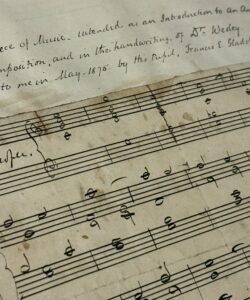
A composer, organist, choirmaster, and church music reformer, Wesley shaped Anglican worship through his hymns, anthems and services. His most famous hymn tunes include ‘Hereford’, typically paired with Charles Wesley’s words to ‘O Thou Who Camest From Above’. A bound volume of S. S. Wesley’s anthems in the Cathedral Library includes ‘O Lord, Thou Art My God’, composed about 1836 while he was at Exeter. The album also contains a fragment of a manuscript score, in Wesley’s hand, of an introduction to an anthem.
Drop in to our special In Focus in the Cathedral Library on Wednesday 22 April between 1pm and 3pm to explore S. S. Wesley’s legacy through manuscripts, correspondence and music.