 By Emma Laws, Cathedral Librarian
Joanna Southcott (1750-1814) was a self-professed prophet, born in Taleford and baptised in Ottery St Mary. She grew up in the village of Gittisham and worked as a shop assistant in Honiton and then as a domestic servant in Exeter. The story of the ‘Exeter Prophetess’ is well known: she claimed to be the Woman of the Apocalypse (Book of Revelation 12:1-6) and pregnant (at the age of 64) with the new Messiah, or Shiloh (Genesis 49:10). Her supposed due-date, 19 October 1814, came and went and she died at the end of December the same year. (The Royal Albert Memorial Museum has several objects relating to Joanna Southcott, including a baby’s rattle and slippers especially commissioned for her expected baby.)
A surgeon, Peter Mathias, was among those who Southcott consulted about her ‘state of pregnancy’ and who was present at her autopsy. The Cathedral Library holds a copy of a tract in which Mathias concluded that it was shameful that ‘multitudes of persons, who in other respects cannot be deemed of unsound minds, have believed from the bottom of their souls in Johanna’s fallacies and delusions’. He further claimed that Southcott, ‘loved to lodge delicately, and feast luxuriously’, and that when she believed herself to be pregnant she had cravings for asparagus – ‘by no means a cheap article of food’. In fact, ‘so strong was her longing, that she is said to have eat at one meal one hundred and sixty heads before she could allay it’.
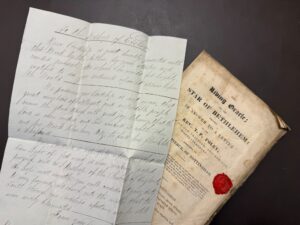
Following Joanna Southcott’s death, various people came forward claiming to be her successor. A couple of weeks ago, while sorting through the boxes containing the Cathedral’s Pamphlets Collection, we came across this curious tract, The Living Oracle, or, The Star of Bethlehem, published in 1830 by John Ward (1781-1837). Born in Ireland, Ward became apprenticed to a shipwright in Bristol. Moving to London, he briefly exchanged ships for shoes, learning the trade of a shoemaker from his brother. Returning to a career in ships, he served as a shipwright in the Battle of Copenhagen before deciding, finally, that he preferred the life of a shoemaker after all. Demonstrating a similar indecision in his religious affiliations, he joined the Calvinists, Methodists, Baptists, and Sandemanians. Eventually he became a follower of the late Joanna Southcott and, around the same time, discovered he had a talent for preaching.
Initially, John Ward supported the claims of Mary Boon of Staverton who professed to be a reincarnation of Joanna Southcott. By 1827, however, Ward was convinced that he had received a divine calling from the spirit of Joanna Southcott. His wife, however, was not convinced; a Southwark Magistrate declared Ward insane and admitted him to Newington Workhouse. Imprisonment seems only to have strengthened Ward’s resolve; upon his release from the workhouse in 1828, Ward took the name Zion and claimed to be Shiloh, the new Messiah.
Ward was certainly industrious; assisted by another convert, Charles William Twort, he preached in various towns and cities, and printed many tracts. This particular tract is accompanied by a handsome handwritten letter to the Bishop of Exeter (Henry Phillpotts), requesting that he give it his ‘attentive and candid perusal’. Ward claims that his followers include ‘great numbers of intelligent, and respectable people’ and that the ‘True Light of God’s word is now making rapid progress’ and, with the Bishop’s assistance, ‘may be still more widely disseminated’. The letter is signed, ‘The United Zion’. The newly appointed Bishop Phillpotts may not have paid the tract or letter quite as much attention as Ward had hoped – and soon he would have more pressing things to deal with when cholera struck Exeter in 1832. To cut a long story short, Twort and Ward were found guilty of blasphemy and assault and imprisoned for 18 months. Supporters even petitioned the House of Commons to release the two men, but to no avail. Ward continued to preach until his death in 1837.