 By Emma Laws, Cathedral Librarian
This year’s theme for British Science Week – Curiosity: What’s Your Question? – encourages us all to be curious about the world around us, and to ask questions. As it happens, this is something the Cathedral Library has been doing for nearly a thousand years. We are in the business of ‘curiosity’; in fact, when the physician George Lipscomb visited the Library in 1799 he noted that it was ‘much visited by the curious’.
This past week, I’ve been considering the history of curiosity and tracing its development from vice to virtue. In the Middle Ages, curiosity was considered a source of sin; after all, curiosity had caused Adam and Eve to sin and to be banished from the Garden of Eden. Evidently, God intended certain things to remain unknown -and who are we to dare to question God? The Cathedral Library has the magnificent 1506 first edition of the earliest collected works of St Augustine (354-430) who famously described curiosity as ‘concupiscentia oculorum’, or, ‘lust of the eyes’.
Curiosity fared better from the 16th century. Leonardo da Vinci’s ‘saper vedere’, or ‘art of seeing’, evolved from his deep curiosity about the world around him. His drawings combined art and scientific observation and demonstrated his belief in the interconnectedness of all things. Later in the 16th century, Francis Bacon (1561-1626) challenged the theological prohibition of curiosity. He believed that curiosity, harnessed by discipline and methodology, could underpin scientific advancement and benefit humanity. In fact, Bacon argued that curiosity is our duty – it glorifies God and brings people to faith. The Cathedral Library has an early edition of Bacon’s Sylva Sylvarum, a collection of curious observations and experiments published shortly after his death.
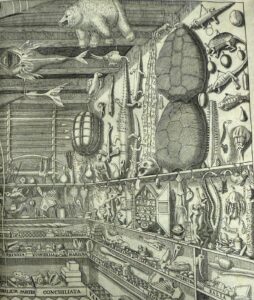
The Renaissance also saw the rise of Cabinets of Curiosities – special rooms in which the wealthy elite displayed their private collections of rare, unusual and exotic objects. These proto-museums played an important role in scientific progress and encouraged close examination and comparison. Curiosity became a mark of status and sophistication. The Cathedral Library has the first edition of Museum Wormianum (1655) – an illustrated catalogue of the bizarre collection of Ole Worm (1588-1654), including an example of a narwhal tusk which people had previously believed was evidence of the existence of unicorns.
In 1660, the Royal Society was founded with the motto ‘Nullius in verba’, or ‘Take nobody’s word for it’. Curiosity became a highly respectable driving force of scientific progress. Inventions, such as telescopes and microscopes, fuelled our curiosity and enabled us to see the invisible ‘works of the Almighty’. One of the great treasures of the Cathedral Library is the first edition of Robert Hooke’s magnificent Micrographia (1665) – the ultimate curiosity book. Hooke used his microscope to answer questions about the natural world, for example, why the bee’s stinger holds fast in the skin and how flies can walk upside down.
Curiosity underwent another transformation in the 18th century. The Enlightenment harnessed curiosity, innovation and experimentation for public purpose. Curiosity, formerly a ‘lust’ to be suppressed, was now a ‘light’ to lead the way. Everyone, not just the elite, could apply curiosity to solving problems for the public good, such as improving transportation and sanitation. Self-education books enabled individuals, both men and women, to enlighten themselves and to satisfy their own curiosity. In Conversations on Chemistry (1806) – another treasure in the Cathedral Library – Jane Marcet (1769-1858) used the format of a make-believe conversation between a teacher and two female students to encourage readers of all ages and stages to develop their understanding of the natural world.
Today, the Cathedral Library remains open to ‘the curious’ (by appointment) Monday to Friday, 10am – 4pm. Come along and satisfy your curiosity!