 By Emma Laws, Cathedral Librarian
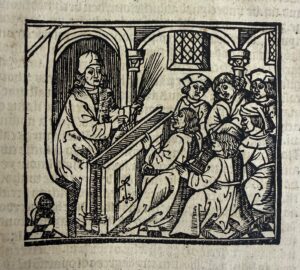
The holidays are here at last and, for many, exams are a distant memory – at least, for now! Most of us will be able to recall the stress of exams, but imagine, for a moment, you’re one of the students in this woodcut, trying to learn Latin grammar while a fierce schoolmaster looms over you with a bundle of birch rods.
This woodcut appears on the title-page to John Stanbridge’s famous Shorte accedence, a Latin grammar textbook that revolutionised the way children learned Latin. It was first printed in about 1495 by Wynkyn de Worde, and by the early 1500s was a staple in classrooms across the country. The title-page woodcut served as a visual representation of how the Tudors regarded a good, robust education and it appeared in other educational textbooks of the time.
The schoolmaster appears on the left, holding his bundle of birch rods – a symbol of his profession and a warning to his students to learn their lessons, or else…! Some of the students are holding open books while others peer over their shoulders; one student, with a fearful expression, appears to be answering a question whilst simultaneously leaning away from the schoolmaster as though expecting a thrashing at any moment.
In the 1500s, there was rather more ‘stick’ than ‘carrot’. It’s hard to imagine that such an image would incentivise children today, but in the 16th century it may well have persuaded parents that the author considered education a serious business and knew how to get results. Stanbridge had no doubt survived a similarly stick-like education at Winchester College before earning his degree at New College, Oxford.
However, while headmaster of Magdalen College School, Stanbridge introduced a new system of learning Latin which explained grammar and syntax in simple English. He taught children the sort of Latin that would engage them, including the odd playground insult, such as ‘thou arte a blabbe’ and ‘thou arte a false knave’. More importantly, children learned the Latin for various excuses for not doing homework: ‘I have forgette my lesson’, ‘I remembre not my lesson’, ‘I am wery of study’, ‘he hath taken my boke from me’, ‘I have blotted my boke’, ‘I lacke a boke’ and ‘I shall begyn my grammer on mondaye’. Unsurprisingly, the children also learned the Latin for: ‘the mayster hath bete me’, ‘the mayster gave me a blowe on the cheks’ and ‘thou lokest on me as thou woldest ete me’.