 By Ian Morter, Priest Vicar
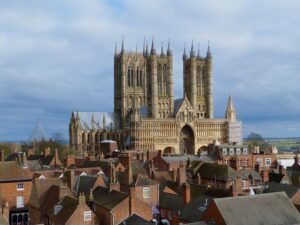
Over the last few months there has been a great focus on the Norman Conquest of England and the influence of 1066 on the course of the history since. One such outcome was the foundation under King William in 1072 of the Diocese of Lincoln, then the largest Diocese of England. The Cathedral build by Remigius de Fecamp, the first Bishop, was originally of a Romanesque design but due to a devastating earth quake in 1185 it was rebuild in the Early English Gothic Style that we seeing today. Set upon a great hill, which also houses the Norman Castle, the Cathedral itself dominates the sky line of the City. That magnificent Cathedral was constructed by Hugh of Avalon who became bishop in 1186 and served until his death in 1200.
It is on him I would like to reflect, as St Hugh of Lincoln is remembered on 17th November, his feast day. Hugh was born in about the year 1140 in the Alpine village of Avalon, situated in the Southeast of France. He came from a minor noble family, his Father, Guillaume, was a Siure d’Avalon. His mother Anne de Theys, had a reputation for kindness, and tended the sores of the lepers in the district, but died when Hugh was only eight years old. At this point his father sent him to the community of The Canons Regular of St Augustine at Vallarbenoit, to receive his religious education. This was not a monastery but community of twelve priest living under the Augustinian Rule of Life. Hugh, at the young age of fifteen, made his profession as a Canon Regular, what we would understand today as a novice within the community. At the age of nineteen, he was ordained a Deacon and sent to assist the priest in the parish of Saint-Maximin who had become frail and could only take the services, so Hugh took on the other pastoral duties of the Parish.
Hugh enjoyed ministering to the parish community, but eventually he desired a more contemplative life that could only be offered in an enclosed monastery. So Hugh went to Grande Chartreuse just 20 kilometres from Grenoble, this was the Mother House of the Carthusian Order. Hugh found there the opportunity to grow closer to God through unbroken silence for prayer and study in their wide collection of books enabling him to have long hours of reading and study. It was in his twenties, that he was ordained priest. In his thirties, he was appointed Procurator, responsible for the temporal affairs of the monetary. During the ten years he held this office, he earned the reputation for efficiency and piety even as far as the court of King Henry II in England.
King Henry, having lost his close advisor when he appointed Thomas Becket, to become Archbishop of Canterbury and with whom he fell out over the Church’s independence from state interference. Henry was rightly implicated in the assassination of Thomas Becket, and subsequently sought forgiveness. Later he wishes to reform the Witham Charterhouse in Somerset and invited Hugh to become the Prior of the first Carthusian monastery in England. Hugh could have well done without this honour, as it would be a distraction from prayer and contemplation. However, with pressure from both from the Bishop of Bath, the Bishop of Grenoble Hugh was compelled to accept the appointment. Hugh set out for England and in 1179 reached Witham where he found the monks in dire straits – dilapidated buildings, lack of money and disputes with displaced locals whose land had been sequestrated.
By 1186 Hugh had presided over the complete rebuilding of the Charterhouse at Witham, and raised not only the numbers within the community but deepened its spirituality. It was then that Hugh’s next challenge would begin. The see of Lincoln was a vacant, a diocese of some nine counties, the bishopric was offered to Hugh by the King with the brief to rebuild the Cathedral that had been devastated a year earlier by an earthquake. Hugh was consecrated Bishop of Lincoln on 21st September 1186 in Westminster.
As a bishop, Hugh was exemplary – he was constantly in residence in Lincoln or travelling within the diocese. He was generous with his finances and charitable. Very scrupulous in the appointments for which he was responsible. He raised the quality of education for the boys at the cathedral school. Hugh was also prominent in trying to protect the Jews, (there were great numbers that lived in Lincoln) during the persecution they suffered at the beginning of Richard I’s reign, Hugh strove to put down popular violence against them.
Hugh was canonised in 1220 only twenty years after his death in 1200 aged 60