 By Noah Thackeray, MA Classics and Ancient History student, University of Exeter
Noah recently practiced his skills in epigraphy (the scientific study of historical inscriptions) at a practical workshop at the Cathedral run by Dr Claire Holleran, Associate Professor of Classics and Ancient History at the University of Exeter.
“Here lyeth y body of John Lant Esq. sometime Maior of this city who died y 17 day of August. Ano Dom 1614”.
Tucked behind the corner of the nave altar is a plain and unassuming epitaph, one which you may have walked by without a second thought, one dedicated to the merchant-turned-mayor, John Lant.
John Lant (1560-1614) was the son of William Lant, an Exeter merchant tailor. He married Elizabeth Lambole in November 1585, at St Petrock’s, across from the Cathedral. Lant began his life as a merchant tailor, before occupying major civic posts in Exeter. He served as Bailiff in 1594 and 1605, Sheriff in 1606, and finally Mayor in 1611. He and his son Richard (also a merchant) made significant contributions to social support in and around Exeter by endowing almshouses for the poor.
“This newe stone was put in the room of another broken and defaced by Lady Susana Lear his granddaughter AD 1680”
Lant’s epitaph is a tale of two halves. Perhaps the more curious is the acknowledgement of the original stone being “broken and defaced”. The stone marking his burial place today is not the original, but a rededication by his granddaughter Lady Susanna Lear (née Lant), eldest daughter of Richard, in 1680. She was born in Kingston-upon-Thames in 1641 and married Sir Peter, 1st (and only) Baronet Lear, of Ipplepen in Devon.
Little is known as to how the original stone was damaged. It is tempting to suppose – given the dates – that the Civil War may have played a role, but it is likely that it was damaged through the routine operations of the Cathedral. We will probably never know the answer but even this later stone is badly eroded, worn down by the impact of daily foot traffic.
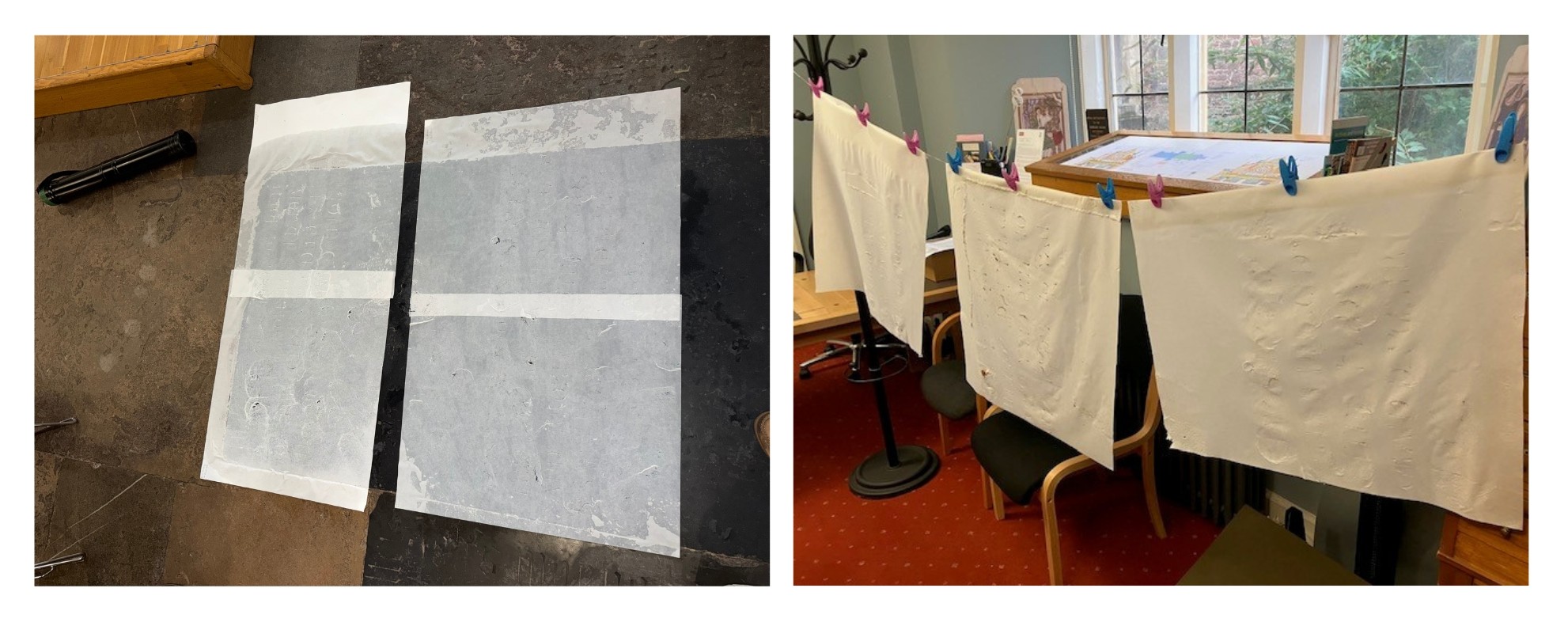
To read this well-worn stone like this one, and begin to decipher its history, we employed a special epigraphical technique known as ‘squeezing’. Large sheets of filter paper are soaked in water and laid over the dampened surface of the inscription. The paper is hit firmly with a dense-bristled brush which, once dried and removed, produces a version of the inscription which can be studied more closely away from the site. This helps logistics and analysis as, sometimes, research sites are dangerous, remote or inconvenient, so having a 1:1 scale, portable copy is beneficial from both a practical and analytical perspective. Epigraphic squeezes have been a staple of archaeological and historical research for many years and remain one of the most useful tools at our disposal.
Photo: Wet squeezes on the Cathedral floor & squeezes drying in the Reading Room