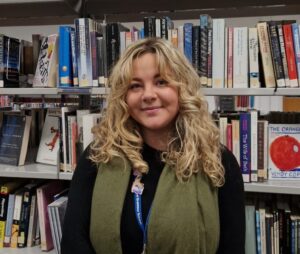
 Did you know? We offer Discovery Days all year round for those looking to find out more about careers in heritage. Our Librarian, Emma Laws, is a Fellow of the Chartered Institute of Library and Information Professionals (CILIP) and a professional registration mentor – this week, Charlotte Bean, Librarian at Colyton Grammar School, reflects on her Discovery Day at Exeter Cathedral Library as part of her journey towards professional registration.
I have been a Librarian in a secondary school since 2022, when I made the move from English teaching. I have absolutely loved my job for the past four years and have no regrets about my career change and, last year, registered to work towards CILIP Chartership. As part of this process, candidates are required to ‘enhance [their] knowledge of the wider professional context and reflect on areas of current interest.’ I recently visited Exeter Library to help me fulfil this criterion and thought the Cathedral Library would be another interesting library to visit.
I really had no idea what to expect when visiting Exeter Cathedral Library and actually felt a bit intimidated before I arrived! Coming from a teaching background and being new to libraries in this job, I know there is still a lot to learn about traditional libraries and librarianship.
However, Emma Laws, the Cathedral Librarian, was so lovely and completely put me at ease. To begin with, Emma spoke to me about her role as the Cathedral Librarian. I learnt that library visits are by appointment; this is partly due to staffing as Emma works part-time and, as much of the material is valuable or fragile, people need to be supervised while accessing it. Additionally, space is limited, so appointments avoid too many people arriving at the same time and being unable to fit into the reading room. This is, of course, very different to my role, where I can expect students to turn up at any time of the day and have all sorts of varied requests – for books, information, help with resources, etc. I am very grateful to the army of Student Librarians I have who, during busy breaktimes, help me immensely by shelving books and supervising the circulation desk, allowing me to attend to student requests and enquiries, and supervising the space. I would be lost without them! [We would be lost without our library volunteers too! – Emma Laws]
Emma also talked about the importance of conservation, and how a large amount of her budget (a generous grant from the Friends of Exeter Cathedral) is put towards preserving the collections. She talked about how, in the past, books had been repaired – and she later showed me an example of a repair job – but she now aims to keep books in as much of their original state as possible, treating the book as an historic object, rather than as a vehicle of information. The Cathedral Library purchases conservation boxes for damaged or fragile books, and these can be expensive, which means Emma must prioritise which books she decides to box. Again, it was interesting to compare this to my job; the majority of my budget is spent on ordering new books and, when a book has reached the end of its life, so to speak, we typically dispose of it, unless it can be easily fixed and still look attractive. I also spend a good amount of time identifying books that should be removed from stock as we frequently run out of room to house new books, whereas Emma is not regularly adding large amounts to the collection so does not need to create the same amount of space.
Where our jobs particularly seem to converge is the promotion we need to do of our libraries, and the active effort we put in to highlight our resources. Emma’s job includes organising and running events, workshops and school visits – and, I was very interested to see the current Treasures Exhibition, including The Exeter Book, which Emma helped to put together. Following the visit, I also looked at the Cathedral’s ‘What’s On’ brochure and saw many recent and upcoming events which sound particularly interesting, including ‘Art of the Book: The Anatomy of Books’ and ‘Exclusive Tour: Spotlight On… Wax Votives.’ While I am lucky to have lots of keen readers in my school, I also need to work hard to keep them interested in the library, particularly as they get older and become busier, so I hold a range of events across the year, such as quizzes, scavenger hunts, competitions and craft activities, and need to make sure I am shouting about the resources we have to offer.
Emma and I also discussed the need to be careful when older books express views and attitudes that are not acceptable today. I hadn’t considered this when thinking about Emma’s role, and Emma talked about ways she warns viewers using books that may contain offensive or sensitive material, especially early books on travel. This made me consider some of the classics we currently have in our library, such as The Adventures of Tom Sawyer, and how it might be prudent to add a warning, or some contextual information, to the beginning of these books.
I particularly enjoyed being shown the part of the Cathedral Library where the older and more valuable books were stored and where I could see the conservation boxes Emma had told me about. Just to look at the books on the shelves was fascinating, but Emma pulled out several items of interest for me, including Exon Domesday, and it was also wonderful to see the large collection of historic medical books which I thought would be very interesting to our GCSE History students, who study ‘Medicine Through Time’. I was surprised to learn that the library collection also includes objects as well as books, and I learnt that these are called realia.
Overall, it was a wonderful visit. I learnt a lot, was able to reflect on my own library and practice, and had a thoroughly enjoyable time! I’d like to say a huge thank you to Emma for accommodating me and finding the time to generously speak to me about the brilliant work she does.