 By Emma Laws, Exeter Cathedral Librarian
In 1753, an Act of Parliament established the Exeter Turnpike Trust. The Trust managed major roads radiating out from the city, connecting Exeter with other major towns and cities such as Crediton, Plymouth, Honiton and, eventually, London. In fact, by the late 1700s, you could get to London by stagecoach in around 24 hours!
Prior to the Exeter Turnpike Trust, road travel was a risky business; roads were rough, uneven and muddy and accidents frequent. The new stone turnpike roads had to be well-maintained so the Trust constructed toll gates and toll houses at various points along major roads. Topsham Road was an important artery for transporting goods and passengers from the port in Topsham to Exeter; the toll house can still be seen on Topsham Road, now called Newport Lodge. The Crediton Road was one of the earliest roads managed by the Exeter Turnpike Trust – two granite milestones still exist on the A377. The London Road to the east was the most heavily used, connecting Exeter to the rest of the country.
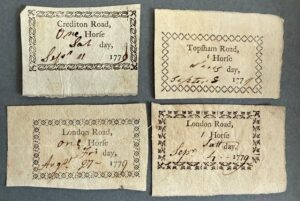
There were various options for travelling on turnpike roads. Stagecoaches were pulled by a team of four horses, which was swapped for a fresh team of horses every 15 miles or so. Wealthier people might hire a private carriage, or post-chaise, pulled by as few as two horses, and ridden by postilions. These tickets, however, were probably purchased by an individual horseback rider. Solo travellers might ride their own horses or, as here, hire a horse at a turnpike inn; a long journey might require the rider to swap a horse for a fresh one at the next inn.
These toll tickets, purchased in August and September 1779 for travel on the Crediton, Topsham and London roads, probably cost a penny each. Toll tickets followed a standard design: a simple border of woodcut ornaments and a minimum of printed text so the tickets could be issued on any day of the year and for any number of horses.
Eventually, the expanding railways offered travellers a faster option than turnpike roads and the Exeter Turnpike Trust finally closed in 1884. But what goes around, comes around: in less than 100 years, Richard Beeching closed around 30% of the country’s railway network as travellers returned to the roads – this time in cars.