 By Emma Laws, Cathedral Librarian
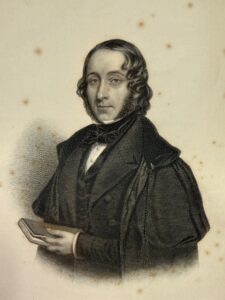
This portrait of Dr Nathaniel Rogers (1808-1884) is the frontispiece to his published lecture, ‘Bibliography, or Books and their History’. In his lecture, Rogers makes the point that books have often resisted ‘the attacks of time’ while other apparently more substantial remnants of the past have not. He says, ‘We see the massive battlements of a castle prostrate in the dust; its walls, once of rocky hardness, fast crumbling into atoms; while manuscripts, penned when its stones were in the quarry, are still perfect in our libraries; their embellishments of gold, silver, and cerulean, still glittering with the freshness of yesterday’.
Nathaniel Rogers qualified in medicine at Edinburgh University in 1832 and practised in Yorkshire and London. He appears to have been a man of many interests and was a frequent lecturer at mechanics institutes and educational and literary societies. These institutes, which spread across the country from the early 19th century, offered adult education and libraries for working people who couldn’t afford membership at the more elite subscription libraries. Rogers’ most famous lecture was on the ‘Mythology of the Ancients’ – a two-part lecture delivered to institutes and literary societies in Southwark, Croydon, Finsbury, Stepney and Scarborough.
In the latter years of his career, Rogers began spending the winter months in Exeter. He presented his lecture on bibliography to members of the Exeter Literary Society (founded in 1841) on 1 December 1869; it was printed in Exeter by The Western Times in 1870. Rogers died in Exmouth at the age of 77 on 27th October 1884.
The Cathedral Library’s copy of ‘Bibliography, or Books and their History’ has a printed insert pasted inside the front cover – a notice of a new stained glass window at Exeter Cathedral. This window, revealed to the public on Christmas Day 1878, was made by Clayton & Bell, and included the words: ‘Dr Nathaniel Rogers gave this window, Anno Domini 1878’. Rogers’ family crest appeared in the upper part of the window.
In fact, Rogers donated stained glass windows to numerous churches, including St Paul’s Cathedral and Westminster Abbey. His window at Exeter Cathedral featured the figures of Abraham, Sarah, Isaac, Rebecca and Jacob as well as three angels. The printed notice pasted inside the Cathedral Library’s copy of ‘Bibliography, or Books and their History’ describes the window as having ‘a very rich appearance’, overshadowing the windows adjoining it.
Sadly, nothing remains of Rogers’ stained glass window at Exeter Cathedral; it was destroyed in the Second World War. But, perhaps Rogers would have felt vindicated by the fact that while his stained glass window did not resist the ‘attacks of time’, his printed lecture remains in the Cathedral Library – as he predicted. It is not ‘perfect’, or ‘glittering’, or embellished in ‘gold, silver, and cerulean’, but it does at least have something of the ‘freshness of yesterday’ and is evidence of a lost piece of the history of Exeter Cathedral and of the role that Dr Nathaniel Rogers played as a benefactor.